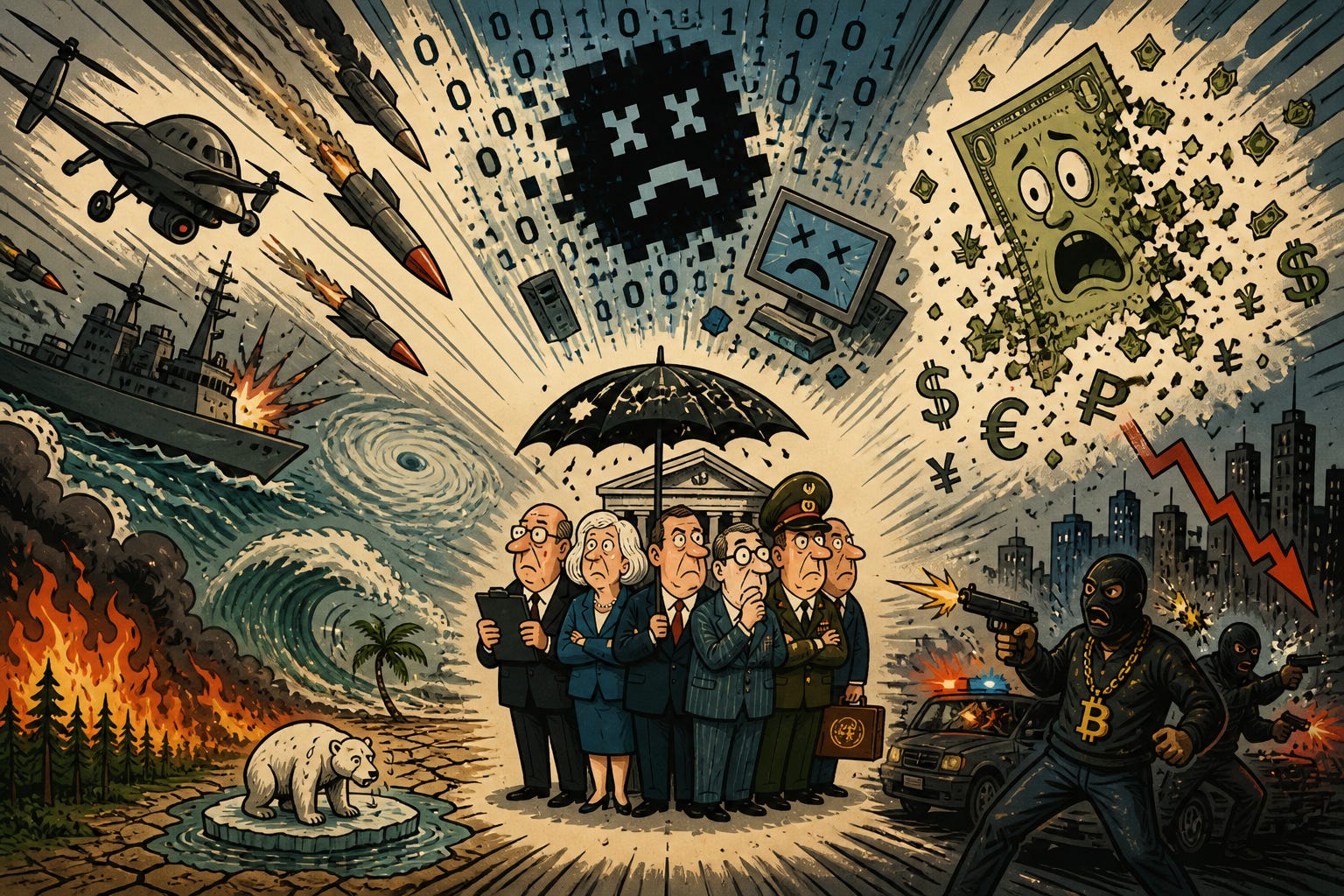
When risks collide
The world's shocks are arriving together. Its institutions are not built for that.
On 27 March 2026, the IRGC announced the Strait of Hormuz closed to any vessel going to and from the ports of the United States, Israel and their allies. Around 20,000 mariners and 2,000 ships were stranded in the Persian Gulf. Major container lines including Maersk, CMA CGM, and Hapag-Lloyd suspended transits. Carriers that had cautiously returned to Suez Canal routes in recent months shelved those plans.
Brent crude surpassed $100 per barrel on 8 March for the first time in four years and rose to $126 at its peak, the largest monthly increase in oil prices ever recorded. The price of everything shipped through the Gulf moved with it. Iran agreed, under UN pressure, to allow humanitarian and fertilizer shipments through the strait, but the concession addressed the symptom rather than the cause. Global fertilizer prices were estimated to average 15 to 20% higher across the first half of 2026 if the crisis continued.
In Cairo, where bread subsidies consume nearly a tenth of the national budget, the government had already revised its import cost projections three times since February. Urea prices, critical to the next planting cycle, had risen 28% in six weeks, because ammonia plants in the Gulf depend on gas that was no longer moving. The harvest was still months away.
And humming away in the background, largely unnoticed, an AI model called Mythos previewed in California prompted three G7 central banks to convene emergency meetings about the stability of the global financial system. These were not separate stories. They were the same story, arriving through different doors.
A systemically risky world
The world has always experienced crises. What it has rarely had is a geopolitical rupture, a climate threshold, a technological step-change, a fiscal squeeze and a political realignment arriving in the same year, each amplifying the others. The problem is not any single shock. It is systemic congestion, the point at which multiple stresses collide faster than institutions can sequence a response.
This is what distinguishes the current moment from previous periods of turbulence. Wars, debt cycles, supply shocks and environmental stress are hardly new. What is novel is their simultaneity, density and transmission speed. The institutional capacity to absorb them — multilateral coordination, fiscal buffers, social cohesion — is thinner than at any point in the post-war era. Risks no longer arrive in sequence. They arrive in combination.
The World Economic Forum’s Global Risks Report 2026 calls this an “age of competition”, defined by geopolitical and geoeconomic rivalry. The diagnosis is right as far as it goes. But competition undersells what is coming. The deeper issue is collision: the point at which geopolitical, economic, climatic, technological and political pressures stop running on parallel tracks and begin reinforcing one another.
War is no longer a discrete event
Geopolitics remains the most immediate source of disruption, but its character has changed. Approximately 60 armed conflicts persist from Ukraine to the Middle East. Strategic tensions around the Taiwan Strait remain a high-impact tail risk. The structural shift is more important than any single flashpoint. War extends far beyond battlefields. It is embedded in trade policy, financial systems, energy markets, technological competition and tensions in outer space.
The Iran conflict illustrates the new pattern. The closure of the Strait of Hormuz after hostilities broke out in February 2026 constitutes a geopolitically driven oil-supply disruption with significant implications for global output, stranding tankers in the Gulf and unsettling energy markets. But the more revealing risk is second-order: Hormuz disrupts fertilizer and feedstock flows, raising urea, ammonia and sulphur costs, which translate into lower yields, higher food prices and sharper fiscal pressure in import-dependent countries.
The same logic applies to semiconductors. Chip supply chains depend not only on fabs and lithography machines but on energy, industrial gases, chemicals and uninterrupted logistics. The Iran war has exposed how energy dependence translates directly into semiconductor vulnerability, particularly for energy-poor Asian manufacturing economies. The rethinking of high-tech supply chains is already under way.
A weaker but not collapsing economy
The global economy is neither robust nor fragile in a conventional sense. It is constrained. Growth continues, but slowly. The UN forecasts 2.7% in 2026 and 2.9% in 2027, well below the pre-pandemic average of 3.2%. Fiscal space is tight. Investment is subdued. Policy flexibility is limited. Slow growth on its own is manageable. The combination of modest growth, repeated external shocks and depleted buffers is not. In that environment, even moderate disruptions such as energy spikes, supply-chain interruptions, and financial volatility produce outsized effects.
Resilience is unevenly distributed. Advanced economies retain institutional depth and financial capacity but face political constraints and rising debt burdens. Many emerging economies confront higher borrowing costs, weaker currencies and greater exposure to climate and commodity shocks. That divergence raises the likelihood that localised fiscal, environmental or political crises spill into regional and global instability.
Trade is changing function, not disappearing
Trade is evolving rather than retreating. The shift is qualitative. Supply chains are being redesigned to meet multiple criteria simultaneously: efficiency, resilience, security and compliance with carbon regimes, data-governance rules, sanctions, and national-security controls.
The result will be a more layered system. It is still global, but more regionalized in key sectors, more duplicated in strategic industries, and structurally more costly. This thickening of globalization reduces vulnerability to single-point failures in critical goods. It also raises prices at the margin and widens the gap between countries that can subsidize domestic production and those that cannot.
Fiscal strain as the central transmission mechanism
Public finance sits at the centre of the emerging risk landscape. Governments are simultaneously facing higher defence spending, industrial policy commitments, demographic pressures, and escalating climate adaptation costs. Borrowing has become more expensive. Political tolerance for fiscal expansion is uneven and, in places, gone.
The constraints are most acute in emerging and developing economies, where debt-servicing burdens are high, concessional finance is shrinking and official development assistance is retrenching. Fiscal stress weakens state capacity. Weak state capacity raises social unrest and drives migration. Migration feeds geopolitical tensions and domestic political instability in receiving countries. The loop is already running.
Climate volatility is becoming systemic
Climate risk is arriving as near-term economic and political disruption, not a distant environmental threat. For the first time, the three-year running average global temperature has pushed through the 1.5°C threshold. Overshoot is no longer hypothetical.
The possible return of a strong El Niño in 2026–27 is the case to watch. El Niño is likely to emerge in May–July 2026 with a probability above 60% and persist through the year-end. A strong event could push heat and weather extremes into 2027, on top of already elevated temperatures. If that coincides with fertilizer shortages and fiscal stress, a climate event stops being an environmental episode. It becomes a macroeconomic and political shock.
Food, water and migration as amplifiers
Climate-related shocks typically propagate through food and water systems before becoming political crises. The Iran-Hormuz closure demonstrates the mechanism: fertilizer disruption raises input prices before harvests are affected, creating a lagged but powerful channel into food inflation. Nitrogen products, especially urea, rose more than 28% within weeks of the strait’s closure. On the current trajectory, the convergence of climate volatility, high energy prices and fertilizer shortages is where 2026–27 is heading.
Food, water and migration intensify existing vulnerabilities rather than creating new ones. Their political effects are sharpest where state capacity is weak, safety nets are thin and trust in institutions is already low, which is precisely where multiple other stresses are also concentrated.
Cyber is now a systemic financial stability risk
The technological landscape is moving faster than the regulatory system tracking it. AI-enabled attacks rose 89% year-on-year in 2025. Breakout time in intrusion incidents has fallen to 29 minutes. The release of Mythos in April 2026 crystallized the shift: the first model to autonomously identify and exploit zero-day vulnerabilities end-to-end, completing in minutes intrusions that would take human hackers days.
The regulatory reaction was coordinated and urgent. The presence of Federal Reserve Chair Jerome Powell alongside Treasury Secretary Bessent in the 10 April emergency meeting was the signal: the issue was being treated as financial stability rather than technology policy. Governor Andrew Bailey said Mythos could “crack the whole cyber risk world open”. He is not a man given to hyperbole.
Cyber and information risks are converging in ways that compound the threat. A growing concern is the erosion of shared factual baselines. Combine AI-enabled intrusion, synthetic media at scale ,and a fractured public sphere, and you have a system in which both markets and electorates can be moved by disinformation indistinguishable from reality until after the damage is done.
Electoral density and political volatility
The political calendar adds another layer of uncertainty. Over 40 democratic contests are scheduled in the coming year. These include the US midterms in November 2026 and elections across advanced and emerging economies in 2027, testing incumbents under conditions of inflation fatigue, migration pressure, climate stress ,and geopolitical unpredictability. Elections are not risks in themselves. The risk lies in what happens when electoral systems operate in a low-trust, high-disinformation environment.
The direction of travel in many democracies is toward sharper ideological positioning on both left and right. Parties and candidates are increasingly rewarded for hard lines on migration, trade, identity, taxation, climate and foreign policy. The result is policy swings that are difficult to model or anticipate. For investors, allies and international institutions alike, that volatility represents a more serious source of uncertainty than at any point since the stagflation and geopolitical turbulence of the 1970s.
The US is the most consequential case. The concern is whether contested narratives, localised unrest, legal challenges, and institutional mistrust convert a routine democratic contest into a source of systemic stress. Climate-related disasters affected at least 94 elections across 52 countries over the past two decades. Electoral integrity increasingly depends on political safeguards alongside physical resilience whether to heat, floods, wildfires, and displacement.
Markets are pricing one world. The ground shows another.
The market disconnect is the most striking feature of early 2026. JPMorgan has raised its year-end S&P target to 7,600. The US tech sector is up 11% in a single month. Anthropic’s private valuation has crossed $1 trillion. Hyperscaler capital-expenditure estimates to 2030 have risen 25% since October alone. The top technology stocks accounted for 53% of the S&P 500’s return in 2025, the highest market concentration on record. The bet, in essence, is that AI-driven productivity will outrun every other variable in the risk environment.
It may not be wrong. Productivity gains from AI may justify real optimism about growth. But the IMF’s October 2025 Global Financial Stability Report warned explicitly of stretched valuations, sovereign-bond market pressure and amplification channels from market turmoil to financial instability, describing investor calm as “apparent” rather than real. The issue is not that markets ignore risk. It is that they price risks individually rather than systemically.
A closed strait is a supply shock. A temperature threshold is an environmental data point. An emergency central bank meeting is a regulatory event. Each is priceable in isolation. What is not easily priceable is the interaction between all three — and the fourth, fifth and sixth shocks still in the pipeline. In an age of collision, individual risk models are the wrong tool. Correlated risks are not what markets price well. They are what breaks systems.
Resilience in a riskier world
For most of the post-war era, the policy task was to contain individual shocks before they propagated: stabilize the bank, ring-fence the conflict, plug the supply line. That model assumed shocks were episodic and the connective tissue between them slow. Neither holds.
The connective tissue is now the fastest-moving part of the system, and the shocks are no longer episodic, they overlap. Whether geopolitical rivalry consolidates into rigid blocs, whether Hormuz disruption spreads further into food and semiconductor systems, whether El Niño materializes, whether Mythos-class capabilities become routine instruments of coercion, whether markets continue pricing calm as these stresses compound: these are no longer separate questions. They are the same question, asked across different domains.
Resilience, in this context, is not preparedness for individual risks. It is the ability to manage their interaction and to see, in the same field of vision, the closed strait, the record index and the central bankers in an unscheduled meeting, and to recognize that they are no longer separate stories. Whether governments, regulators and investors can hold that picture in mind is the test of the decade. So far, by the evidence of a few months in 2026, only some of them are looking up.
Robert Muggah Robert Muggah is co-founder and principal of the SecDev Group and co-founder of the Igarapé Institute, a Brazil-based think and do tank ranked the world’s top social policy organisation in 2019. A political economist with a doctorate from Oxford, he has spent three decades advising governments, F100 companies, the UN, the World Bank and the Inter-American Development Bank on public security, organised crime, smart cities, and climate and nature-based solutions across more than 50 countries.
For more reading on systemic risks:
Muggah, R. (2026) Seven reasons why the old order broke - and how middle power might define the new one, Agenda, WEF, 28 April, https://www.weforum.org/stories/2026/04/7-reasons-old-order-broke-middle-powers-might-define-the-new-one/
Muggah, R. (2026) How war in the Middle East has exposed the vulnerability of global chokepoints, Agenda, WEF, 31 March, https://www.weforum.org/stories/2026/03/war-middle-east-vulnerability-global-choke-points/
Muggah, R. (2026) The global price tag of war in the Middle East, Agenda, WEF, 12 March, https://www.weforum.org/stories/2026/03/the-global-price-tag-of-war-in-the-middle-east/
SecDev’s geopolitical risk practice - builds on three decades of fieldwork across 120+ countries industrialized into on-demand strategic advantage. The era of treating geopolitical risk as an externality is over. Supply chains now span hostile borders, critical technologies depend on adversarial states, and market access hinges on diplomatic whims. What was once the domain of foreign ministries has become every CEO’s problem. SecDev’s Intelligence as a Service delivers tiered, contract-free engagement: from real-time assessments that move faster than markets to deep-dive analysis that uncovers the networks and contacts buried in geopolitical complexity. The question isn’t whether geopolitical shocks will hit your business - it’s whether you’ll see them coming.