

Ukraine: the (in)-ground truth
Western governments see Kyiv's deposits as a hedge against China. But geological promise becomes strategic autonomy only slowly, and only downstream.

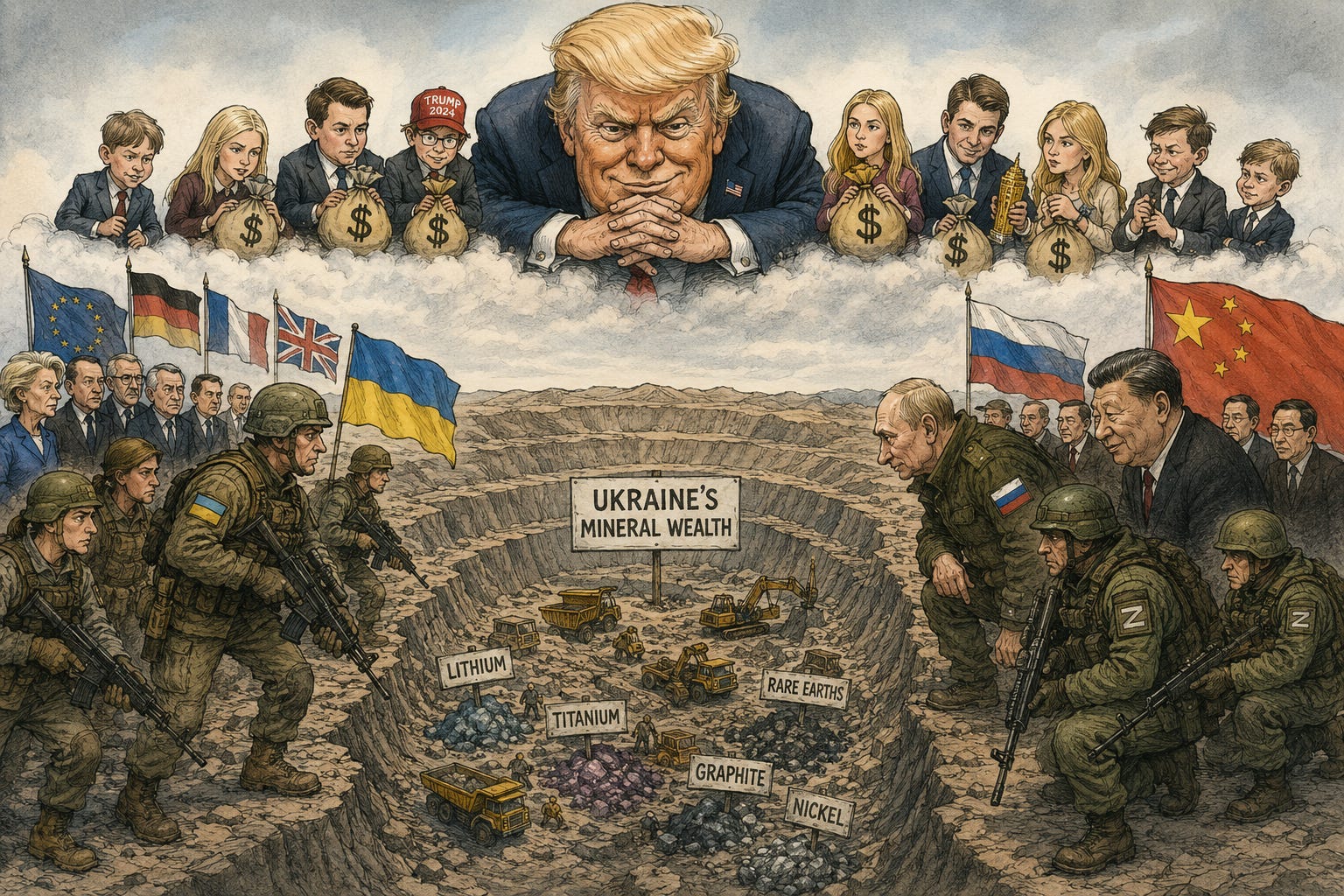
In the new geography of power, minerals have become instruments of statecraft. The scramble for graphite, lithium, titanium and rare earths is no longer a specialist concern of geologists and commodity traders. It is a test of industrial sovereignty. America and Europe increasingly view Ukraine as more than a country fighting for survival. They see its resource abundance as a strategic hedge against China’s grip on the minerals and processing capacity behind the clean-energy, digital and defence industries of the modern economy.
Promise is not production
Ukraine is often described as holding a large share of Europe’s critical raw-material potential. It holds 25 of the EU’s 34 critical raw materials and 22 of the 50 materials designated as strategic by the United States. Brussels had already seen the opportunity before Russia’s full-scale invasion. In July 2021 the EU and Ukraine launched a strategic partnership to integrate raw materials and battery value chains. Washington has since followed with a more explicit geopolitical instrument. The US-Ukraine Reconstruction Investment Fund seeks to increase investment in mining, energy and related technology, while recognising Ukraine’s sovereignty over its natural resources.
The West’s green and digital transitions depend on materials whose supply chains are narrow, opaque and politically exposed. An electric motor or a missile-guidance system is clearly a feat of engineering. It is also a bundle of mineral dependencies. For governments and companies that spent decades assuming that efficiency was the highest virtue in global commerce, the discovery that efficiency often meant dependence has been sobering. Ukraine’s mineral base is attractive precisely because it appears to offer geographic proximity, political alignment and geological promise at once.
Yet the mineral story is more complicated than the rhetoric of a trillion-dollar treasure chest suggests. Geological promise is not the same as commercial supply. A deposit must first survive the long passage from prospect to bankable project: modern surveys, certification, permits, finance, infrastructure and finally commercial production. In Ukraine many deposits rely on Soviet-era surveys, incomplete reserve data and restricted geological information. The European Parliament has warned that many rare-earth claims depend on outdated mapping that did not assess commercial viability, and that some sites may be unprofitable to extract.
The distinction is crucial. Mineral potential is only the first step towards mineral wealth. Mineral wealth becomes strategically useful only when it is converted into industrial capacity that is secure, competitive and well governed. Ukraine has geological promise and an important mining inheritance. What it still lacks is the stable platform required to turn both into strategic autonomy. That does not diminish the opportunity. It puts it in proportion.
The treasure map is contested
Nor are all Ukraine’s minerals safely under Kyiv’s control. Ukrainian officials say that about 20% of the country’s mineral resources and roughly half of its rare-earth deposits are under Russian occupation. SecDev analysis identified about 9,500 discrete mineral, mine, quarry, deposit and well sites across 177 types of mineral and water resource, and estimated that Russia controlled almost 2,000 of them, more than a fifth of known Ukrainian mineral deposits. This gives the question of minerals an unusually literal connection to sovereignty. Territory determines not only borders, but balance sheets.
The war has therefore changed the meaning of a geological map. A deposit in a contested or occupied region does not only unsettle investors; it also carries broad geopolitical connotations. Investors may study it, governments may cite it and analysts may assign it a theoretical value, but no serious project can proceed without secure access, enforceable property rights and functioning infrastructure. Even deposits in safer regions carry the broader risk premium created by war. Insurance becomes expensive and logistics fragile. Energy supply becomes uncertain and skilled workers may be displaced or mobilised.
Even in ostensibly secure areas, the mineral windfall is likely to be smaller and more conditional than many assume. Ukraine has a long mining tradition in coal, iron ore, manganese, graphite, titanium and uranium-related sectors. This industrial inheritance matters. It means the country is not starting from scratch. It has engineers and technical universities, an industrial culture and rail corridors that many other would-be critical-mineral suppliers lack. But the minerals attracting the most strategic attention, especially lithium and rare earths, are far less developed. Ukraine has four main lithium deposits, two in the centre and two in the east and south-east. None produces lithium at industrial scale.
The Dobra project may contain substantial lithium carbonate equivalent, but remains at the exploration stage and would require significant capital before production. Other deposits are less accessible, less studied or more expensive to process. The International Energy Agency (IEA) notes that, globally, major mines coming online between 2010 and 2019 took more than 16 years on average to move from discovery to first production. Ukraine must attempt this under wartime conditions, with damaged infrastructure, constrained public finances and a crowded reconstruction agenda.
This is why claims about vast mineral riches should be handled with care. SecDev’s 2022 headline estimate of $12trn, for example, included hydrocarbons, coal and theoretical in-ground values that do not deduct the costs of extraction, processing, transport, storage, remediation or capital. Some assume access to deposits that are occupied or close to the front. Others blur geological occurrence with economically recoverable reserves. The result is a kind of strategic inflation. Ukraine’s mineral base is real. Its immediate fiscal bonanza is not.
Ukraine will not quickly replace China. It cannot. Its strategic value lies in becoming one node in a broader allied strategy of redundancy. In minerals, redundancy is power. The goal is resilience rather than autarky: a system with enough alternative suppliers, processors and stockpiles to withstand coercion or disruption.
China’s real grip is downstream
China’s dominance is deep in the middle of the supply chain, where ore is converted into usable industrial material. The IEA reported in 2025 that China is the leading refiner for 19 of 20 strategic minerals it analysed, with an average market share of around 70%. In rare earths the chokepoint is even more acute. Separation, refining, metals, alloys and permanent magnets are difficult to build, capital-intensive and dependent on accumulated technical know-how.
This is why the Ukrainian opportunity reveals the scale of the Western problem. Digging up more ore is necessary but insufficient. A lithium deposit does not make a battery industry. Graphite in the ground does not make battery-grade anode material. Rare earths are not strategically useful until separated, refined and turned into oxides, metals, alloys and magnets. China’s leverage lies precisely in these midstream and downstream chokepoints. Beijing has shown a willingness to use them. Recent Chinese export controls and licensing requirements have targeted materials such as gallium, germanium, graphite, antimony, tungsten and rare-earth-related items, underscoring how mineral supply can become a tool of statecraft.
The West is vulnerable because China has built an industrial ecosystem around these materials, not merely because it mines or refines so much. Processing plants sit close to chemical suppliers, component manufacturers and export logistics. Engineers move between firms. State banks, local governments and industrial planners have tolerated low margins and high environmental costs to build scale. The result is a system that competitors cannot easily copy by announcing a mine or subsidising a single refinery.
Ukraine could still matter greatly, provided Western governments avoid the old habit of treating mining as separate from manufacturing. A Ukrainian graphite project is more valuable if linked to European battery-anode production. Titanium is more strategic if tied to aerospace and defence supply chains. Lithium is more useful if processed into chemicals that meet battery-grade standards. Rare earths matter most when separation and magnet-making capacity also exist somewhere in the allied system. Otherwise Ukrainian ore may still travel through Chinese-controlled or Chinese-influenced channels before returning as a component embedded in a Western product.
Europe has learned this the hard way. The EU’s Critical Raw Materials Act sets 2030 benchmarks for extraction, processing and recycling, targets that read less like a declaration of autonomy than an admission of dependency. Ukraine could help only if it is treated as part of an industrial strategy rather than merely a mining frontier. That means pairing Ukrainian ore with allied refining, credible environmental oversight, reliable infrastructure and long-term offtake agreements. Otherwise Ukraine risks supplying raw materials to someone else’s industrial strategy.
The hard work starts after the hype
The capital requirements will be large. Mines need power, water, transport and, above all, security. Processing plants need chemical expertise and predictable regulation. Investors need bankable reserve estimates, transparent licensing and political-risk insurance. War has damaged Ukraine’s energy and transport infrastructure and raised the cost of moving heavy industrial materials. The US-Ukraine fund and European development-finance interest may help, but private capital will wait for underlying conditions that make projects commercially plausible and physically secure.
This is also why governance matters as much as geology. Resource booms can strengthen states, but they can also corrode them. Ukraine will need transparent and accountable processes, from licensing and community consent to clear rules on taxation and revenue use. It will also need to avoid a reconstruction model in which mineral assets are treated as collateral for wartime support or sold under pressure before their value is properly assessed. This explains why the sovereignty language in the US-Ukraine investment framework is central to the legitimacy of the whole enterprise.
Recycling will also help, but it will not eliminate the need for new mining. Europe’s own targets recognise this. Batteries, electronics and magnets already contain valuable materials, but many of the technologies now being deployed will not enter recycling streams for years. Collection systems remain uneven and some critical minerals are used in quantities that are difficult to separate economically. Recycling can reduce exposure over time. It cannot satisfy the near-term surge in demand for electrification and defence production by itself.
Ukraine’s mineral strategy is credible only when understood as a hedge rather than a jackpot. For Ukraine, responsibly developed minerals could attract foreign investment, create skilled jobs and anchor the country more firmly in European defence, aerospace, battery and clean-energy supply chains. For Washington and Brussels, Ukraine offers a nearby, politically aligned and geologically promising partner at a time when dependence on Chinese refining and components has become a strategic liability. For China, the emergence of Ukraine as a credible supplier would not end dominance, but it could gradually narrow the room for coercion.
The most sensible policy is therefore neither mineral romanticism nor fatalism. Ukraine’s resources should not be pledged away cheaply in the hope of immediate cash, nor dismissed because they cannot transform supply chains overnight. They are an option on a more resilient industrial future. Exercising that option will require security and patient capital. It will also demand investment in better geological data, modern infrastructure and governance strong enough to resist both corruption and predation. Critical minerals may help Ukraine win the peace. But first Ukraine must be able to mine, refine and govern them.
Robert Muggah is co-founder and principal of the SecDev Group and co-founder of the Igarapé Institute, a Brazil-based think and do tank ranked the world’s top social policy organisation in 2019. A political economist with a doctorate from Oxford, he has spent three decades advising governments, F100 companies, the UN, the World Bank and the Inter-American Development Bank on public security, organised crime, smart cities, and climate and nature-based solutions across more than 50 countries.
Selected articles on critical minerals and rare earths in Ukraine
Muggah, R. and Rohozinski, R. (2025) The mineral wars: how Ukraine’s critical minerals will fuel future geopolitical rivalries, Horizons 29, https://www.jstor.org/stable/48829721
Muggah, R. and Dryganov, V. (2022) Russia’s resource grab in Ukraine, Foreign Policy, https://foreignpolicy.com/2022/04/28/ukraine-war-russia-resources-energy-oil-gas-commodities-agriculture/
Muggah, R. and Medish, M. (2025) The great rewiring: how Ukraine’s war is unravelling the old world order and hastily stitching together a new one, Washington Spectator, October 31st, https://washingtonspectator.org/the-great-rewiring/
Muggah, R. (2022) How the war in Ukraine is triggering a re-evaluation of global systemic risk, Agenda, World Economic Forum, https://www.weforum.org/stories/2022/06/ukraine-war-global-systemic-risk-resilience/
BBC, Scramble for Rare Earths interview (2022), https://www.bbc.com/audio/play/p0d34hfp
A sample of coverage of SecDev in the following outlets
BBC (2025) https://www.bbc.com/news/articles/c20le8jn282o
Der Spiegel (2025) https://www.spiegel.de/wirtschaft/ukraine-diese-rohstoffe-will-donald-trump-von-wolodymyr-selenskyj-a-38ef3965-794a-48be-af6e-b15d46a59982
Mining Technology (2025) https://www.nprillinois.org/2025-02-26/5-minerals-in-ukraine-that-may-be-part-of-a-deal-with-the-u-s
NBC (2025) https://www.nbcnews.com/politics/national-security/know-ukraines-mineral-wealth-rcna194070
NPR (2025) https://www.nprillinois.org/2025-02-26/5-minerals-in-ukraine-that-may-be-part-of-a-deal-with-the-u-s
Unherd (2025) https://unherd.com/newsroom/can-britain-benefit-from-ukraines-minerals-deal/
Washington Post (2025) https://www.washingtonpost.com/world/2025/02/28/ukraine-us-rare-minerals/
SecDev’s geopolitical risk practice - builds on three decades of fieldwork across 120+ countries industrialized into on-demand strategic advantage. The era of treating geopolitical risk as an externality is over. Supply chains now span hostile borders, critical technologies depend on adversarial states, and market access hinges on diplomatic whims. What was once the domain of foreign ministries has become every CEO’s problem. SecDev’s Intelligence as a Service delivers tiered, contract-free engagement: from real-time assessments that move faster than markets to deep-dive analysis that uncovers the networks and contacts buried in geopolitical complexity. The question isn’t whether geopolitical shocks will hit your business - it’s whether you’ll see them coming.