The middle ground
Brazil and Canada have the minerals the world needs. The harder task is controlling what happens after they leave the ground
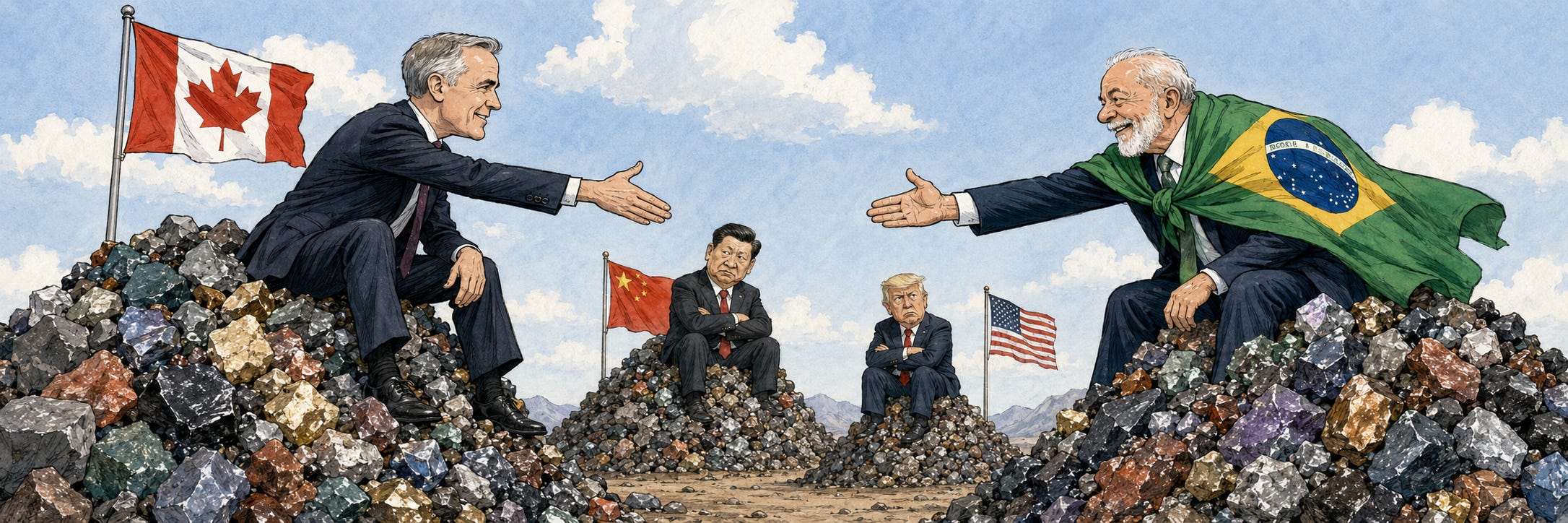
When Canada's prime minister, Mark Carney, visits Brasília, the official agenda will be crowded. Trade and climate will feature prominently. So will Ukraine, Iran, and the familiar rituals of bilateral diplomacy. Yet the most important conversation may concern a subject that barely registered in government briefings a decade ago. Critical minerals have moved from the margins of trade policy to the center of economic security. Brazil and Canada now find themselves unusually well-placed in this new mineral diplomacy.
The bottleneck is in the middle
For decades, raw materials were treated as ordinary commodities. Countries dug them up where there were promising reserves, shipped them where costs were lowest, and trusted markets to handle the rest. That approach no longer works in a world beset by an energy transition, technological acceleration and rising militarization. Minerals such as cobalt, copper, graphite, lithium, nickel and rare earths are now essential to electric vehicles, wind turbines, batteries, data centers, fighter jets, and advanced weapons systems.
The problem is not only who has these minerals underground. The more serious choke point is what happens after they’re mined. Minerals have to be separated, refined and processed before they can be used in batteries, magnets and other high-value products. This middle part of the supply chain is where China has built its strongest position.
China understood the importance of this stage earlier than most countries. Subsidies and weaker environmental rules helped. Yet the more fundamental explanation is less flattering to the west. China spent decades building the factories, engineers and know-how that others let move offshore. It now processes around 90 per cent of the world’s rare earth separation and refining and produces roughly 94 percent of sintered permanent magnets.
Beijing has used its processing power as leverage before, including during the disruption of rare earth shipments to Japan in 2010. More recently, it restricted exports of antimony, gallium, and germanium in 2024. Licensing controls on seven medium and heavy rare earth elements followed in 2025. China has also tried to extend its reach over foreign-made products containing even small amounts of Chinese-origin rare earths.
The United States was late to respond, but it is now moving quickly. Since 2020, Washington has treated critical minerals as an economic-security priority. It has used the Defense Production Act and the Inflation Reduction Act to secure mineral assets while building the Minerals Security Partnership (now called FORGE) with allies to support alternative supply chains. Processed minerals are now treated less like ordinary inputs and more like strategic national security assets.
Two middle powers, two strategies
Brazil and Canada matter because both countries have serious mineral strength. Brazil dominates global niobium, a metal used in steel, pipelines, jet engines and other advanced industries. It accounts for roughly 93 percent of global production. Brazil also has among the largest known rare earth reserve bases and important deposits of cobalt, copper, graphite, lithium, manganese and nickel. Canada is one of the world’s most trusted mining jurisdictions, with strength across many of the same mineralsand a growing rare earths sector.
Both countries have resources, institutions, and diplomatic reach. But they also enter any partnership with different degrees of exposure. Canada operates within a Western security architecture that shapes what it can offer and what it will ask for. Brazil operates outside it, deliberately. That gap is not easily bridged by bilateral goodwill or talk of a new multipolar order.
A closer partnership will not be easy. Canada’s Bombardier and Brazil’s Embraer spent years fighting over aircraft subsidies at the World Trade Organization. Agricultural trade disputes have produced their own friction. Vale’s 2006 takeover of Inco, then Canada’s largest nickel miner, left deep wounds in Sudbury. A prolonged strike in 2009-10, the hollowing out of local management, and a perception that Brazilian ownership put shareholder returns above workforce commitments. They are the reason Canadian labor and community groups will approach any new bilateral minerals partnership with suspicion.
The two countries have also taken different paths to mineral diplomacy. Canada has generally aligned more closely to the United States and its European allies. It joined the G7 Critical Minerals Production Alliance, created a CAD$2 billion Critical Minerals Sovereign Fund, and tightened screening of Chinese investment in sensitive assets. Brazil has kept more room to manoeuvre. It welcomes Chinese investment in lithium, accepted a $565 million Development Finance Corporation package for Serra Verde in February 2026, and signed the EU-Mercosur agreement in January 2026.
Canada has leaned into trusted supply chains. Brazil has pursued a deliberate strategy of extracting capital from all sides without committing to any. But Brazil’s multi-alignment has a structural vulnerability: almost all mineral output, regardless of who finances the mine, ends up in Chinese processors. In the first quarter of 2025, copper exports to China surged 180 percent and manganese 310 percent. Opening the door to more partners has not yet changed where the output goes.
They also face a common problem. Opening a new mine does not solve dependency if the minerals still have to be processed somewhere else. Building a refinery is not enough if there are too few skilled engineers to run it well. A new rare earth separation plant in Canada or Brazil would face fierce competition from Chinese firms with scale, experience and lower prices. Without price floors, long-term purchase agreements or production credits, many non-Chinese projects will struggle when prices fall.
Build a corridor
The politics, however, will be harder than the economics suggests. Brazil’s foreign ministry has spent fifty years building a doctrine of strategic autonomy — the right to trade, invest and align with any partner without being captured by any. Any corridor framed as an alternative supply chain architecture, or read in Brasília as a request to restrict Chinese investment, will fail before it begins.
The proposals have to be designed as instruments Brazil would pursue in its own interest regardless of its geopolitical preferences. This means domestic processing requirements that apply to all investors, not only Chinese ones. It means FPIC protocols that improve bankability regardless of who is buying. And it means production credits that make Brazilian midstream competitive on cost rather than dependent on allied goodwill.
None of that makes the partnership less worth pursuing. A Canada-Brazil minerals partnership makes sense because the two countries bring different strengths. Canada has strong standards, close ties to allied markets and a reputation for reliable governance. Brazil has scale, industrial ambition, and a long list of potential projects. Working together would give both countries a better chance to build capacity in the middle of the supply chain.
Figure 1: Canada-Brazil: Critical Mineral Superpowers
They could begin with a bilateral corridor for rare earths and battery materials. The aim should be clear, focusing on joint investment, shared technology, and purchase commitments long enough to justify the capital. The corridor could focus on a small number of serious projects, agreed technical standards, and a realistic ten-year path to commercial production.
Skills will be as binding a constraint as capital. In 2024, China’s universities produced about 382,000 postgraduate engineering graduates alone. Canada’s engineering pipeline is much smaller: the latest national figures show roughly 17,000 undergraduate engineering degrees and 12,000 graduate engineering degrees. Brazil sits somewhere between the two, with a larger training base than Canada but nothing close to China’s scale.
Three decades of offshoring midstream work produced a generational gap that cannot be closed by funding alone. Brazil and Canada should expand graduate training, create placements in operating plants, speed up recognition of technical credentials, and recruit experienced process engineers.
Allied governments are good at helping companies raise money to build new facilities. They are less good at helping those facilities survive difficult market conditions. The real test is whether plants can keep operating when Chinese competitors push prices down. Production tax credits and minimum price guarantees could make the difference between a strategic asset and another stranded project.
Canada should also look at Mercosur differently. It is more than a distant trade bloc. Trade negotiations resumed in October 2025, with officials aiming for a signed agreement by late 2026. The EU’s Critical Raw Materials Act carries binding single-source concentration thresholds: no more than 65 percent of any strategic mineral from a single country. Brazil is one of the few jurisdictions with the reserve scale to anchor supply under those rules. That is a mandated demand signal that cannot be met without deep Mercosur engagement. It could also facilitate a bridge between Canadian capital, Brazilian projects and European buyers.
Projects that lack support from Indigenous peoples and affected communities face delays, legal challenges, and higher costs. They may also lose access to buyers that care about environmental and social standards. Better monitoring and emergency response systems would strengthen the corridor as well. These are the tools that help supply chains withstand shocks.
None of this is guaranteed. Brazil and Canada have announced minerals ambitions before, only to watch them fade into institutional inertia, financing gaps and electoral cycles. This time the pressure is stronger. Rivals are moving quickly. The wars in Ukraine and the Middle East have shown that supply chain disruption is now part of the global economy.
Countries that act early will help write the rules. Countries that wait will have to live by them. When Carney and Lula sit down in Brasília, they will be testing whether two middle powers can be valued for more than what lies beneath their soil. The real question is whether they can build what the world needs above it.
Robert Muggah is co-founder and principal of the SecDev Group and co-founder of the Igarapé Institute, a Brazil-based think and do tank ranked the world’s top social policy organisation in 2019. A political economist with a doctorate from Oxford, he has spent three decades advising governments, F100 companies, the UN, the World Bank and the Inter-American Development Bank on public security, organised crime, smart cities, and climate and nature-based solutions across more than 50 countries.
SecDev’s geopolitical risk practice - builds on three decades of fieldwork across 120+ countries industrialized into on-demand strategic advantage. The era of treating geopolitical risk as an externality is over. Supply chains now span hostile borders, critical technologies depend on adversarial states, and market access hinges on diplomatic whims. What was once the domain of foreign ministries has become every CEO’s problem. SecDev’s Intelligence as a Service delivers tiered, contract-free engagement: from real-time assessments that move faster than markets to deep-dive analysis that uncovers the networks and contacts buried in geopolitical complexity. The question isn’t whether geopolitical shocks will hit your business - it’s whether you’ll see them coming.