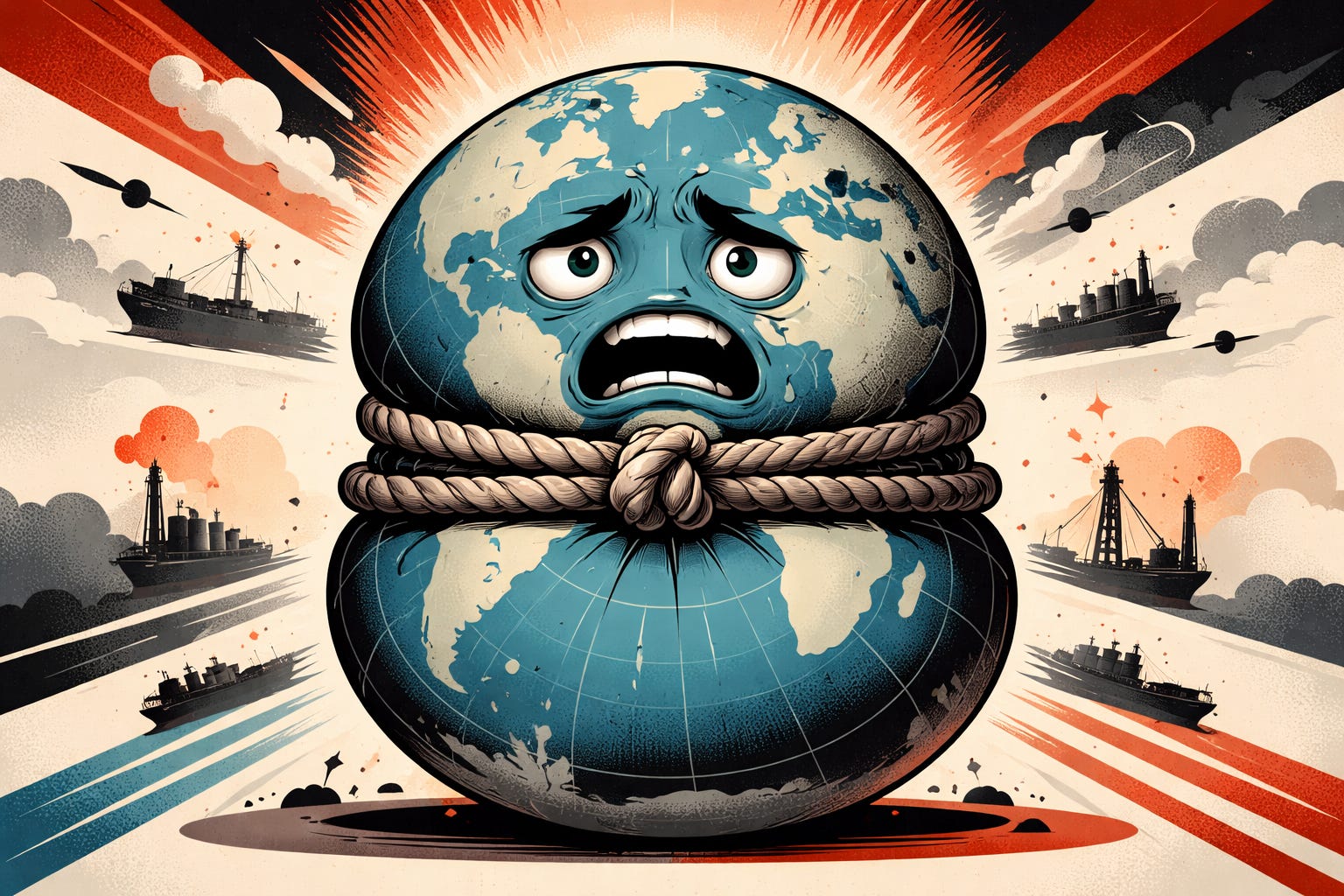
The chokepoint economy
The world's chokepoints were always fragile. It took a war in Iran to remind everyone.
For centuries, chokepoints were the specialist concern of admirals, traders and a small priesthood of supply-chain analysts. The war in Iran has changed that. Narrow passages and concentrated systems are once again shaping conflict escalation, energy prices, and financial stability far from any battlefield. As tensions around the Strait of Hormuz have escalated this month, the old lesson has returned: modern power still runs through a surprisingly small number of vulnerable arteries.
This is not new. In the first world war, the struggle over the Dardanelles was driven by the strategic importance of a narrow waterway linking the Mediterranean to the Black Sea. In the second, the Battle of the Atlantic was essentially a contest over whether Britain and its allies could keep open the sea routes on which the war depended. Chokepoints did not merely influence those conflicts. They helped determine their outcome.
What has changed is not the logic but the object. Chokepoints are no longer just straits, canals and mountain passes. They sit inside server farms, lithography systems, cable landing stations and the processing chains for the minerals feeding the green and digital economy. Geography still matters. So does industrial concentration.
The old map still rules
Start with the obvious. Hormuz remains the clearest bottleneck with global reach. The strait carried roughly one-fifth of global oil and petroleum consumption and a similar share of LNG trade in 2024 and early 2025. That alone would make it critical. But the real vulnerability lies in the dependencies stacked on top of it: petrochemicals, fertiliser feedstocks, shipping insurers and financial expectations all move when Hormuz is threatened. The Iran war has made that abstract interdependence suddenly concrete.
A related vulnerability runs through the Malacca Strait into the South China Sea and the Taiwan Strait. Malacca is the world’s busiest oil transit corridor, linking Gulf producers to east Asia’s industrial economies. The South China Sea carries roughly one-third of global shipping making it one of the world’s most consequential maritime corridors. Any conflict over Taiwan would threaten not just semiconductor production but the maritime routes surrounding it.
The Red Sea offers another reminder. Disruption around Bab el-Mandeb showed how quickly attacks on shipping cascade into freight rates, delivery schedules and food markets. Pressure on Suez and Panama, combined with conflict in the Red Sea, has extended routes, pushed up ton-mile demand and raised costs across global supply chains. Chokepoints do not need to close to matter. It is often enough that they become unreliable.
Climate has entered the equation
Panama has added a distinctly 21st-century twist. For most of the modern era, strategic vulnerability at chokepoints was associated with war, piracy or blockades. In Panama, the problem has been drought. Reduced water levels constrained canal traffic and forced shippers to reroute or wait — precisely the kind of friction that tightly optimised supply chains handle badly. Climate stress is now a first-order geopolitical variable. A canal does not need to be bombed to become a strategic liability. It can simply run out of water.
That matters because it broadens the risk map. Investors and policymakers are accustomed to treating geopolitical shocks as exceptional events. They are far less comfortable with a world in which the same chokepoint can be stressed by missiles one year and rainfall patterns the next. That is now the operating reality.
Silicon has its own straits
The more profound shift lies beyond maritime geography. Taiwan is the most striking example. The island dominates global foundry capacity and produces most of the world’s most advanced logic chips. That has turned the Taiwan Strait into a double chokepoint: a shipping corridor on one side, a fabrication bottleneck on the other. A war there would not just imperil trade routes. It would cut the supply of components underpinning everything from smartphones and cloud computing to missiles and modern vehicles.
South Korea is a critical node in memory — particularly high-bandwidth memory, the technology enabling advanced AI systems. And in the Netherlands, ASML occupies an even more refined bottleneck: it remains the sole commercial supplier of extreme ultraviolet lithography machines, without which the most advanced semiconductors cannot be mass-produced. The geography is different. The logic is identical. A narrow strait is not the only place where small interruptions produce very large consequences.
What once would have been described as an industrial policy issue is now plainly strategic. The map of vulnerability no longer ends at the shoreline. It extends into clean rooms, equipment supply chains, and a handful of firms that are not easily substituted.
The new battle for materials
The same concentration runs through critical minerals. The IEA has warned that China is the leading refiner for 19 of 20 important strategic minerals. That is not a commercial statistic. It means that the industries meant to define the coming era — batteries, electric vehicles, wind turbines, defence electronics — are exposed to a small set of processing hubs and policy decisions made in Beijing.
China is not just a chokepoint in mineral refining. It is also a chokepoint in the manufacturing systems of the clean-energy transition. From rare-earth magnets used in electric vehicles, wind turbines, drones and missiles to solar panels manufacturing and battery cells. China occupies commanding positions across the industrial supply chains meant to power the next era.
This is why a discussion of chokepoints can no longer stop at oil. Rare-earth magnets, cobalt processing, lithium chemicals and graphite anodes do not have the drama of the Suez Canal or Hormuz. But they have something almost as consequential which is the capacity to halt industrial systems upstream. A tanker blocked in a strait is visible. A refined mineral that fails to arrive at a cathode plant is not. The damage can be just as severe.
Data now travels through narrow gates too
The world imagines the internet as diffuse and decentralized. Its physical infrastructure is anything but. Subsea cables carry the overwhelming majority of intercontinental traffic, and Egypt has become one of the critical passage points for cables linking Europe and Asia. By one estimate, more than 90% of Europe-Asia subsea cable capacity runs through the Red Sea cable corridor. This is a chokepoint of a different kind, one whose disruption would ripple through finance, cloud infrastructure, and government operations.
That should change how governments think about resilience. Ports, canals and pipelines still matter. So do cable landing stations, data centres and logistics hubs like Singapore, Rotterdam and Dubai, where physical and digital systems are increasingly fused. A modern economy does not distinguish neatly between commodity flows and information flows. It depends on both arriving reliably.
Vulnerability is the point
The strategic significance of chokepoints lies not just in their throughput but in the absence of substitutes. A route becomes dangerous when detours are costly, spare capacity limited and downstream systems tightly coupled. That is why a missile strike in the Gulf can feed into food prices in Africa, factory schedules in Europe and monetary anxiety in Washington. It is also why a crisis in Taiwan would go global fast.
The war in Iran has done more than issue a regional warning. It has exposed, again, the fragility of a global order built on narrow corridors and concentrated capabilities. In quieter times, these chokepoints are easy to overlook — efficiency disguises dependence. In wartime, or even prolonged crisis, they reappear as what they always were: hidden levers of escalation.
That was true at Gallipoli and in the Atlantic. It is true now in Hormuz, Suez and the South China Sea. The difference is that today’s chokepoints also include chip fabs, lithography tools and fibre-optic cables on the ocean floor. The map of vulnerability has widened. The underlying logic has not.
What does Polymarket have to say?
* A version of this article was originally published as an opinion piece by the World Economic Forum.
Robert Muggah Robert Muggah is co-founder and principal of the SecDev Group and co-founder of the Igarapé Institute, a Brazil-based think and do tank ranked the world’s top social policy organisation in 2019. A political economist with a doctorate from Oxford, he has spent three decades advising governments, F100 companies, the UN, the World Bank and the Inter-American Development Bank on public security, organised crime, smart cities, and climate and nature-based solutions across more than 50 countries.
SecDev’s geopolitical risk practice - builds on three decades of fieldwork across 120+ countries industrialized into on-demand strategic advantage. The era of treating geopolitical risk as an externality is over. Supply chains now span hostile borders, critical technologies depend on adversarial states, and market access hinges on diplomatic whims. What was once the domain of foreign ministries has become every CEO’s problem. SecDev’s Intelligence as a Service delivers tiered, contract-free engagement: from real-time assessments that move faster than markets to deep-dive analysis that uncovers the networks and contacts buried in geopolitical complexity. The question isn’t whether geopolitical shocks will hit your business - it’s whether you’ll see them coming.