The Ballot and the Bullet
Across Latin America, organised crime is not just killing people, it is also killing democracy
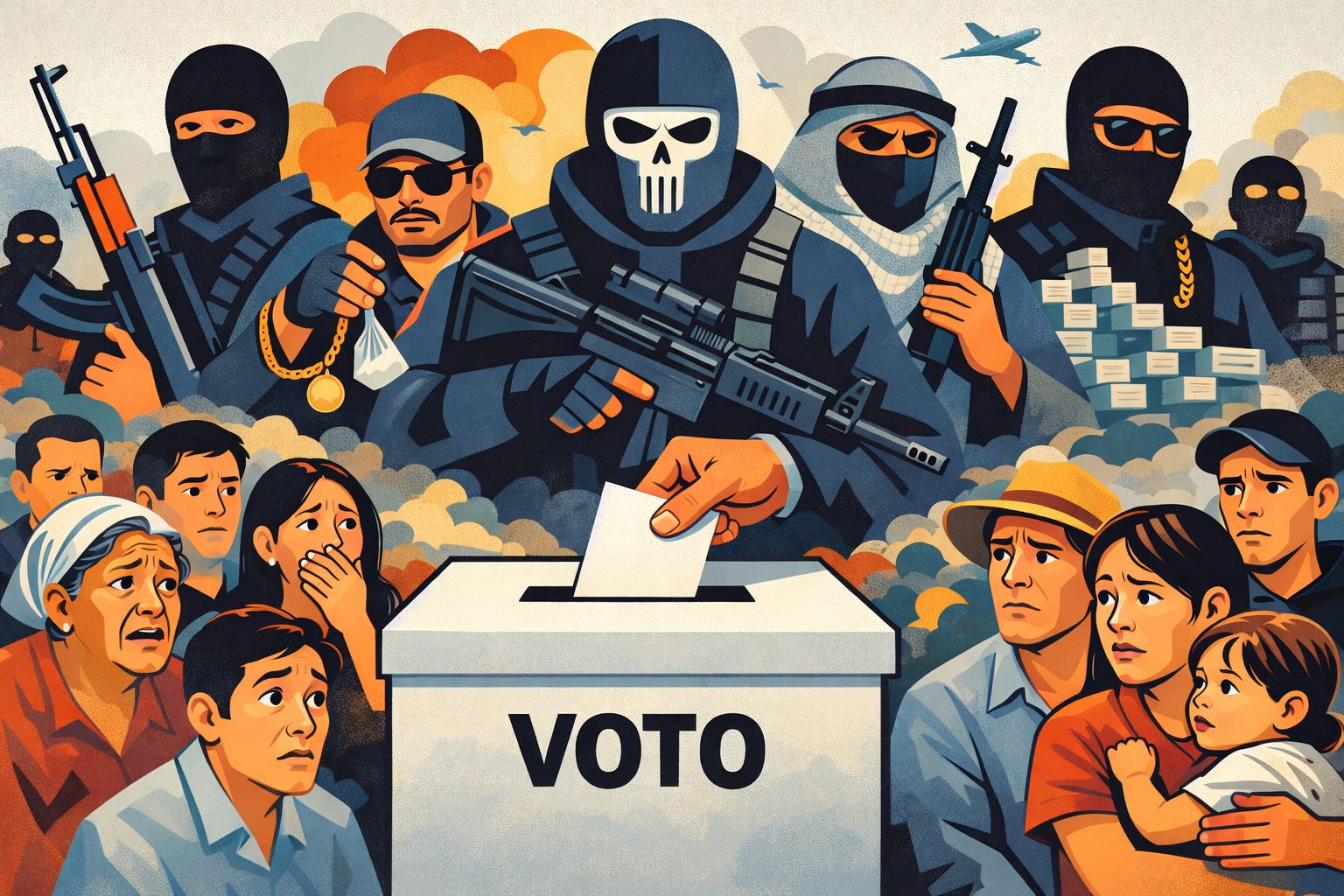
Chile’s presidential runoff ended on December 14 with José Antonio Kast, a hardline conservative, cruising to victory (Reuters). His campaign was dominated by crime, migration, and a spreading sense that the state had lost its grip. The scale of the result matters less than what it signals. Across Latin America and the Caribbean, organized crime is no longer only just a law and order problem. It is reshaping democracy by changing both the facts on the ground and the feelings in voters’ heads.
Over the past decade, the criminal violence story has been uneven. While several countries in Central America and elsewhere have reported meaningful reductions from prior peaks, the region remains disproportionately violent by global standards. The Caribbean has remained especially volatile, with smaller countries exposed to sudden spikes that can swamp politics overnight.
Yet even as killings have stabilized or declined in parts of Latin America, fear has stayed stubbornly high, and in some places has intensified as violence becomes more visible in countries once considered relatively safe. Public concern about crime is often “more an indicator of fear” than a clean reflection of victimization. In a 2024 regional survey, the share of respondents naming crime as the principal problem is described explicitly as a measure of anxiety. That paradox is fertile ground. Criminal groups exploit it by governing through intimidation. Politicians exploit it by translating unease into a simple electoral bargain: trade safeguards for the promise of control.
The new politics of control
The physical shift is easiest to see below the national level. Criminal groups are increasingly less interested in the presidency than in the plumbing of the state: municipal contracts, port access, zoning permits, transport unions, procurement, local police appointments and local elections. Capturing a mayor’s office is cheaper than capturing the palace, and it yields quicker returns. As criminal markets diversify beyond drugs into extortion, illegal mining, migrant smuggling and cyber scams, the incentive to dominate local economies and local politics intensifies. The pressure tends to show up through three mechanisms.
The first is coercion. Threats, selective killings and intimidation narrow the field of who is willing to run, who is willing to campaign, and which alliances are possible. The second is suppression. Violence deters participation. People stop attending rallies. Volunteers vanish. Candidates withdraw. In some places turnout falls, and the effects can linger beyond one cycle as fear becomes normalized. The third is substitution. Where citizens feel abandoned, security becomes the only real question on the ballot, and repression is sold as a substitute for the slow work of reforming police, courts, prisons and anti corruption systems.
The perceptual shift is just as consequential. Fear does not need to match actual victimization to move votes. In many countries, political mood is driven less by homicide charts than by lived insecurity: extortion at the shopfront, armed robberies on commuter routes, viral videos of spectacular violence and the nagging suspicion that criminals are the real authority in certain neighborhoods. Candidates who can credibly perform control, especially on the right, turn that gap into electoral advantage.
When the strongman becomes a template
The emblem of substitution politics is El Salvador’s president, Nayib Bukele. Since March 2022, his government has ruled under a rolling state of exception that expands police powers and curtails due process, enabling mass arrests on a scale rarely seen in a democracy. The policy machinery is reinforced by hardening the criminal code, widening the net around alleged gang affiliation, and treating detention itself as the central instrument of control rather than an endpoint of careful investigation.
Bukele’s flagship monument is the CECOT mega prison, built to hold up to 40,000 inmates. It functions as more than a jail. It is a theatrical claim that the state can identify the enemy, capture it and warehouse it at industrial scale. For anxious voters, the message is not subtle. The government is willing to do whatever it takes. Few governments can replicate El Salvador wholesale. Many are borrowing the political technology anyway: emergency powers, militarized policing, tougher sentencing and highly visible prison expansion.
Ecuador is the clearest example of a country trying to move at Bukele speed under very different conditions. In January 2024 President Daniel Noboa declared an “internal armed conflict”, bringing the military into domestic security operations. In June 2025 lawmakers approved reforms that expanded crime fighting powers, increased penalties and made it easier to seize assets tied to criminal groups. Rights advocates warned that emergency posture can outlast the emergency, while criminal groups adapt rather than disappear.
Honduras has leaned into similar symbolism. In mid 2024 President Xiomara Castro’s government announced plans for a 20,000 inmate megaprison, alongside proposals to treat certain gang crimes as terrorism and pursue collective trials, all framed as necessary to confront a security emergency. Even before the prison is built, the declaration does political work. It signals resolve, speed and punishment. It also shifts the debate toward spectacle and away from the dull work of building investigative capacity and improving courts.
Costa Rica’s shift is politically striking because it long sold itself as Central America’s safe exception. In 2025 the government indicated that it was setting-up a high security facility modelled on El Salvador’s template. The proposed prison, called CACCO, is designed to hold 5,100 inmates and expand national prison capacity by roughly 40%, with a reported price tag of about $35 million and Salvadoran technical input. For a country that once treated insecurity as a distant problem, prison architecture has become a way of signalling deterrence and reassuring voters that the state still has authority.
Other borrowings are more legalistic than exceptional. Argentina has moved through “anti mafia” tools intended to speed investigation and prosecution. Peru’s version is less a single model than repeated emergency governance, with successive states of emergency and military deployments in response to extortion and public outrage. Chile has not embraced mass detention, but it has steadily expanded the armed forces’ role at the border, reflecting how crime and migration have fused into a single agenda.
The pattern is clear. The iron fist is no longer a slogan reserved for fringe candidates. It has become a baseline expectation, a test of seriousness. The question in many campaigns is no longer whether to be tough. It is how tough, how fast, and how far beyond normal rules.
The democracies beneath the headlines
Brazil shows how intimidation need not decide a national election to corrode democracy. It raises the cost of politics locally, shrinks the pool of candidates willing to run, and hardens campaign incentives. It also helps explain why law and order rhetoric becomes more than policy. In areas where militias and criminal factions govern by threat, promising “order” is also a claim about who governs the streets.
That logic was on brutal display in Rio de Janeiro in late October 2025, when a vast police operation against Comando Vermelho left roughly 122 people dead (including 5 police officers), triggering demands for investigation. The episode sharpened a national argument about organized crime, the acceptable use of force, and whether spectacular crackdowns are becoming the default currency of seriousness in security policy.
Mexico illustrates coercion and suppression most starkly. Ahead of the June 2024 elections, the country was hit by a wave of political murders, with at least 34 candidates or aspirants assassinated between September and May, and warnings that some municipalities were too dangerous even to host polling booths. The strategic logic is often hyper-local involving control over policing, procurement and territory. The democratic effect is distortion. Candidates avoid neighbourhoods altogether, campaign behind armoured protection, or withdraw. Voters are left choosing within constraints imposed long before election day.
Chile’s story is different but no less instructive. Its homicide rate remains low by regional standards, yet public anxiety surged as organised crime, violence and migration became fused in political debate. Kast’s campaign offered voters a blunt bargain including tougher borders and tougher policing in exchange for a promise of restored normality. The broader lesson is that politics does not wait for a country to resemble Ecuador at its worst. It reacts the moment voters feel their society is becoming unrecognisable.
Washington’s hard line and Latin America’s hard men
This regional hardening is being reinforced from the north. When Donald Trump returned to the White House in 2025, he revived an old argument in sharper form. Drugs and migration, the administration insists, are not merely policy problems. They are security threats that justify extraordinary measures. In the 2025 National Security Strategy, the Western Hemisphere is elevated as a core arena, explicitly tying stability to curbing migration and fighting cartels and transnational criminal organizations.
Washington cannot pick presidents at will. But it can change incentives. It reshapes what campaigns are about, what counts as serious policy, and what voters are told is realistic.
Start with narrative. By treating migration, cartels and violence as one fused threat, the United States exports a frame that local politicians find electorally convenient. It collapses complex realities into a simple question: who can restore control. That framing accelerates convergence, pushing candidates to compete on hardness rather than on the fine print of reform.
Then comes coercive diplomacy. Deportations are not just border policy, they are leverage. In January 2025 Colombia briefly refused to accept deportation flights on U.S. military planes. The standoff ended after Washington threatened steep tariffs and other measures, and Bogotá agreed to accept the flights.
A third channel is the escalation of the drug war into a quasi wartime frame. When Washington treats organized crime as an existential threat, it legitimises extraordinary responses by partners and makes restraint look like weakness. Terrorism designations and sanctions tools set a tone that travels fast. In February 2025, the United States designate major transnational gangs and cartels - including Tren de Aragua, MS-13, Sinaloa, and Jalisco New Generation - as Foreign Terrorist Organisations. In December 2025 it added Colombia’s Clan del Golfo. The designations do more than expand prosecutorial reach. They encourage emergency language at home and raise the political payoff to counter terror posturing.
None of this creates Latin America’s insecurity. But it amplifies the market for control politics. It rewards spectacle over institutional depth. It makes the Bukele template look less like an outlier and more like a baseline.
A harder future is not inevitable
The danger is not only stolen elections. It is hollowed elections that are formally competitive, substantively constrained by intimidation, fear, and a policy menu narrowed to punishment. Bending the trajectory requires changing what is rewarded politically.
First, it is critical to protect democracy where it is most exposed. Local candidates, councillors, journalists, election officials and civic organisers are the easiest targets and the most essential to competitive politics.
Second, it is vital to rebuild state capacity where organized crime actually makes money. Ports, borders, prisons, logistics corridors, extractive zones and tourist hubs are where capture pays. Professionalizing police forces, strengthening prosecutors and witness protection, and insulating courts from political interference matter more than one more emergency decree.
Third, target the illicit economy. Money laundering, procurement corruption and extortion markets are the revenue engines of criminal governance. Make those harder to monetise and violence becomes harder to sustain.
Finally, change the politics of security itself. Democracies need an agenda that is firm and lawful, fast and accountable. Otherwise the region will keep trading tomorrow’s safeguards for today’s feeling of control, and discovering too late that fear is a terrible long term currency.
Robert Muggah is co-founder and principal of the SecDev Group and co-founder of the Igarapé Institute, a Brazilian think tank ranked the world’s top social policy organisation in 2019. A political economist with a doctorate from Oxford, he has spent two decades advising governments, the UN, the World Bank and the Inter-American Development Bank on public security and organised crime across more than 50 countries. His recent work examines how criminal governance is reshaping Latin American democracies - from the “Bukele effect” spreading across the hemisphere to the geopolitics of Washington’s renewed drug war and why violent police raids in Rio de Janeiro won’t fix the problem.
The Risk Ahead
SecDev’s geopolitical risk practice - builds on three decades of fieldwork across 120+ countries industrialized into on-demand strategic advantage. The era of treating geopolitical risk as an externality is over. Supply chains now span hostile borders, critical technologies depend on adversarial states, and market access hinges on diplomatic whims. What was once the domain of foreign ministries has become every CEO’s problem. SecDev’s Intelligence as a Service delivers tiered, contract-free engagement: from real-time assessments that move faster than markets to deep-dive analysis that uncovers the networks and contacts buried in geopolitical complexity. The question isn’t whether geopolitical shocks will hit your business - it’s whether you’ll see them coming.