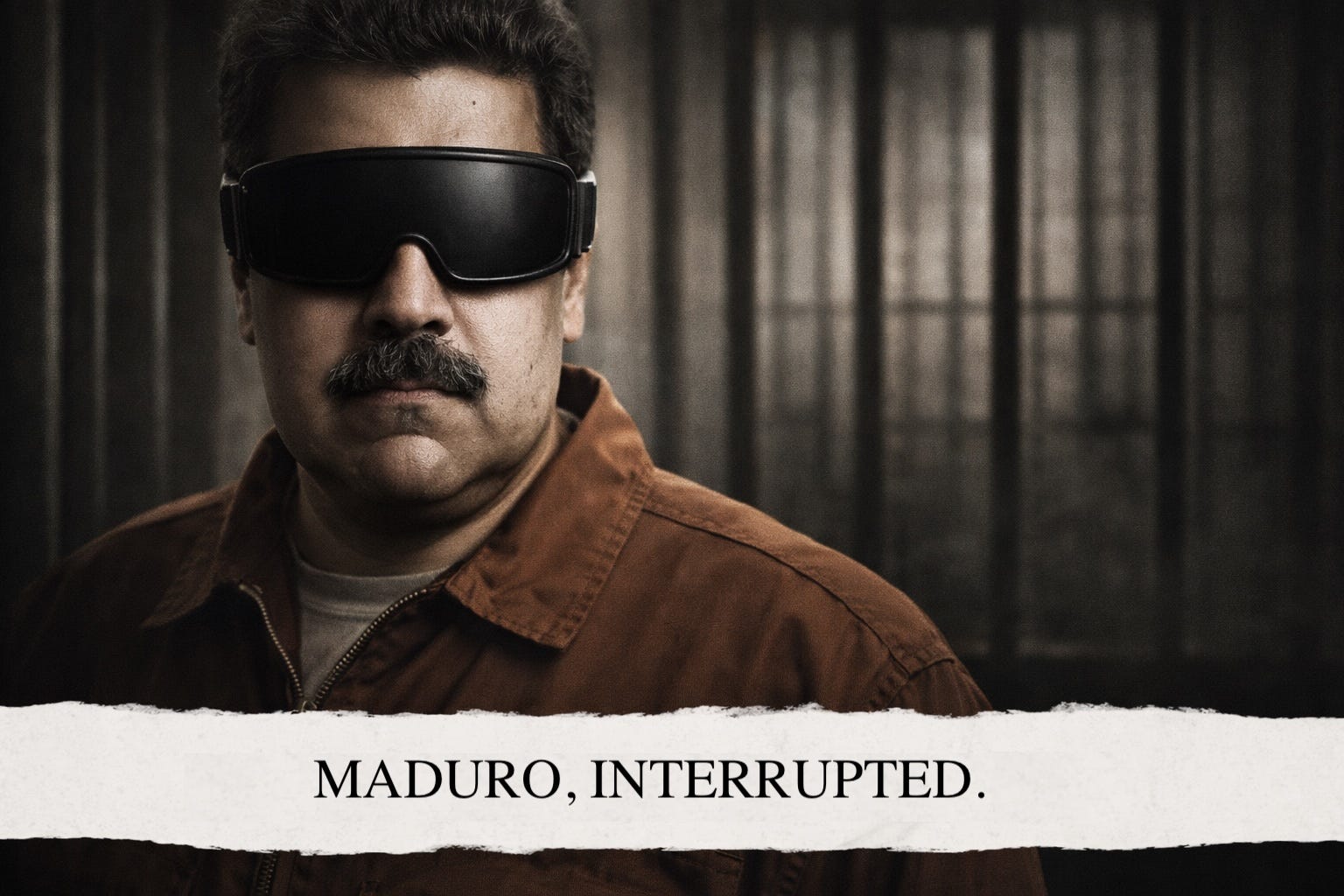
Maduro, Interrupted
Washington's predawn raid removed a president but not a regime. Five scenarios for what follows.
The predawn extraction of Nicolás Maduro from Caracas may have caught observers off guard, but the underlying logic was telegraphed months earlier. The Trump administration’s National Security Strategy, published in December, articulated an unambiguous vision of hemispheric primacy, one that explicitly identified Venezuela, along with Cuba and Nicaragua, as vectors of extra-regional influence that the United States would no longer tolerate.
What surprised was not the if but the how. Rather than a conventional military intervention, Washington opted for a surgical law enforcement operation, wrapping regime destabilization in the procedural language of counter-narcotics and extradition. Maduro is now in a New York courtroom rather than exile in Havana or Moscow. And crucially, the chavista state apparatus remains standing: decapitated but intact.
This hybrid approach, forceful yet calibrated, destabilizing yet oddly conservative, opens a complex range of possible futures for Venezuela. Writing in The Conversation, SecDev’s Dr. Robert Muggah maps five scenarios ranging from a swift American withdrawal that leaves a reconstituted chavismo in place, to popular uprising, to a messy hybrid conflict that could see the country lurch through years of managed instability.
The implications extend well beyond Caracas. This is Monroe Doctrine 2.0 in action, and regional actors from Bogotá to Panama City to Ottawa are taking note.
Robert Muggah is co-founder and principal of the SecDev Group and co-founder of the Igarapé Institute, a Brazilian think tank ranked the world’s top social policy organisation in 2019. A political economist with a doctorate from Oxford, he has spent two decades advising governments, the UN, the World Bank and the Inter-American Development Bank on public security and organised crime across more than 50 countries. His recent work examines how criminal governance is reshaping Latin American democracies - from the “Bukele effect” spreading across the hemisphere to the geopolitics of Washington’s renewed drug war and why violent police raids in Rio de Janeiro won’t fix the problem.
SecDev’s geopolitical risk practice - builds on three decades of fieldwork across 120+ countries industrialized into on-demand strategic advantage. The era of treating geopolitical risk as an externality is over. Supply chains now span hostile borders, critical technologies depend on adversarial states, and market access hinges on diplomatic whims. What was once the domain of foreign ministries has become every CEO’s problem. SecDev’s Intelligence as a Service delivers tiered, contract-free engagement: from real-time assessments that move faster than markets to deep-dive analysis that uncovers the networks and contacts buried in geopolitical complexity. The question isn’t whether geopolitical shocks will hit your business - it’s whether you’ll see them coming.