Iran's Crypto Off-Ramp Is Beijing
How the weaponisation of Western finance is building the alternative financial system that will outlast it
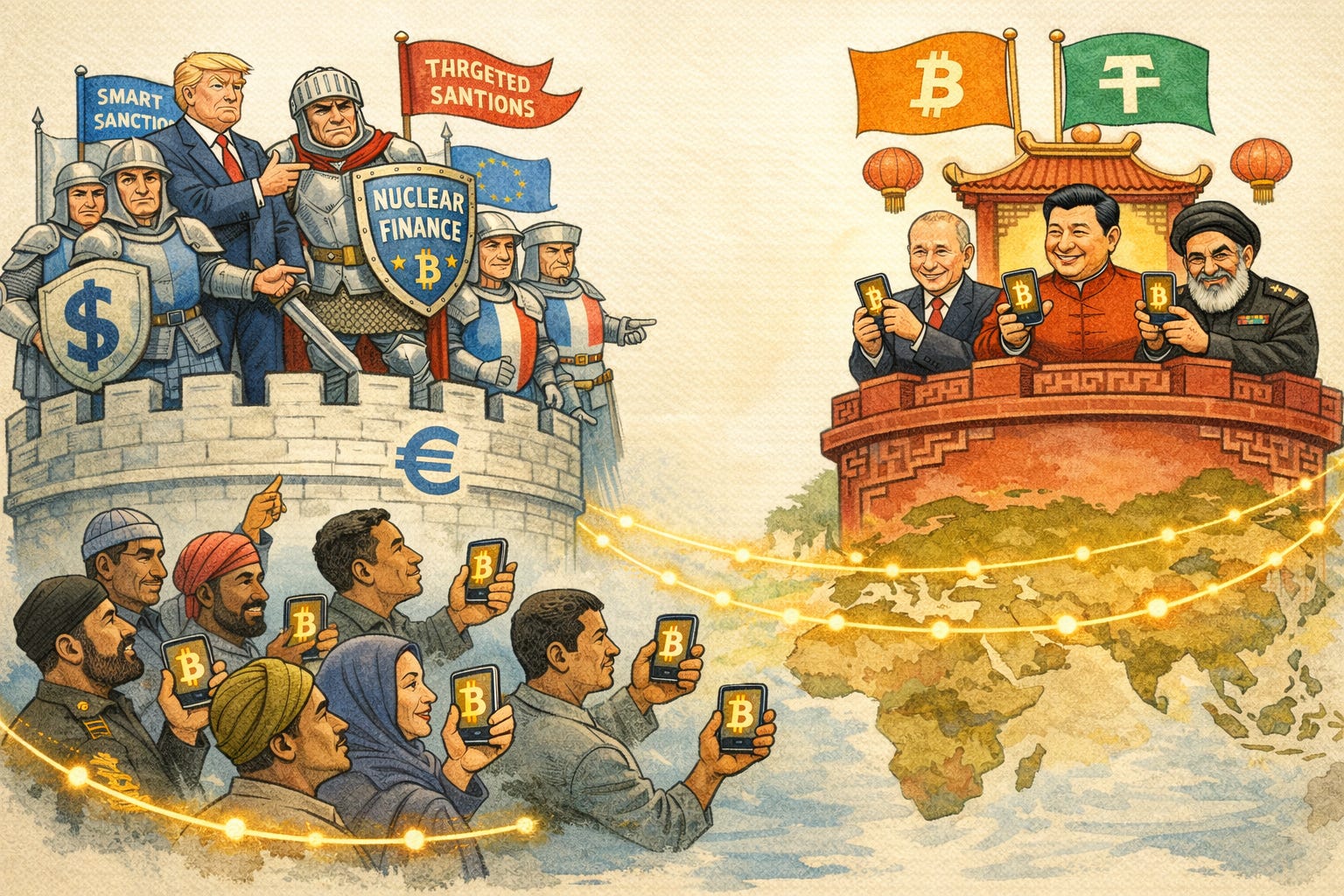
The Treasury secretary’s words were chosen for maximum effect. Scott Bessent, standing in the White House briefing room on Wednesday 16 April 2026, promised that the United States would deliver the “financial equivalent” of the bombing campaign against Iran: a cascade of secondary sanctions aimed at any bank, company, or country that dares to touch Iranian oil money. The language was martial. The logic was familiar. And, like much that passes for financial statecraft in Washington these days, it rests on an assumption about the architecture of global finance that is increasingly out of date.
The assumption is that the dollar is still the only game in town.
The hollow victory in the Gulf
Bessent’s announcement was not without substance. The same day, the US Treasury imposed sanctions on an oil-smuggling network operated by Mohammad Hossein Shamkhani (son of the late Ali Shamkhani, a close adviser to Iran’s former Supreme Leader), targeting more than two dozen individuals, companies, and vessels involved in moving Iranian and Russian oil through UAE-based front companies. More consequentially, Bloomberg reported that two Chinese banks, whose names Treasury declined to disclose, had received letters warning that evidence of Iranian money flowing through their accounts would trigger secondary designation. The temporary waiver that had allowed 140 million barrels of Iranian oil to reach global markets since 20 March expires on 19 April and will not be renewed, as Reuters first reported on Tuesday.
Against this backdrop, the UAE’s own crackdown has real teeth. At the end of March, Iran International reported that UAE authorities had detained dozens of IRGC-linked money changers, shut down associated companies, and told others to leave the country. The arrests were described by Iran International as “one of the most serious blows yet to Tehran’s sanctions-evasion network.” Miad Maleki, a former senior US Treasury sanctions strategist now at the Foundation for Defence of Democracies, explained why. “The UAE is the single most critical jurisdiction in the Iranian regime’s sanctions-evasion architecture,” he told the outlet, adding that the arrested sarraf networks (informal money changers whose “trust-based relationships, bank accounts and corporate structures are not quickly replaceable”) had for years converted Iranian oil proceeds into dollars, dirhams, and euros beyond the reach of the domestic banking system.
The UAE compliance reflects something specific: deep integration into dollar clearing and correspondent banking that makes secondary sanctions a genuine existential threat. For institutions that live and die by their access to the US financial system, the threat is credible. The enforcement logic, within this layer, is sound.
The problem is that Tehran’s most resilient financial channel no longer runs through this layer at all.
The crypto layer that secondary sanctions cannot reach
Iran’s cryptocurrency ecosystem reached $7.78 billion in on-chain activity in 2025, according to Chainalysis, growing at an accelerating pace. IRGC-linked addresses accounted for approximately 50% of total Iranian crypto inflows in the fourth quarter of that year, receiving more than $3 billion over the course of 2025; Chainalysis describes this as a conservative lower bound, covering only wallets already identified through OFAC and Israeli sanctions designations. In early April, Iran extended this logic to maritime trade: Bloomberg first reported on 1 April that the IRGC was already extracting transit tolls from vessels in the Strait of Hormuz, with fees starting around $1 per barrel of oil, payable in yuan or stablecoins via an IRGC-linked intermediary. The Financial Times subsequently quoted a spokesperson for Iran’s Oil, Gas and Petrochemical Products Exporters’ Union confirming that shipping companies would be required to pay in cryptocurrency. Chainalysis assessed in a 10 April report that Iran would likely prioritise stablecoins over Bitcoin for these payments, “consistent with the heavy historical reliance on stablecoins by the regime and its regional proxies to engage in illicit trade and sanctions evasion at scale.”
The preferred instrument is USDT-TRC20, Tether’s dollar-pegged stablecoin operating on the Tron blockchain. It is fast, stable, and denominated in dollars without requiring dollar correspondent banking at any point in the settlement chain. Here the conventional analysis reaches the boundary of its understanding. It is often said that crypto’s “off-ramp dependency” is the binding constraint: you eventually need to convert into fiat, and that fiat conversion layer is where enforcement bites. That is true for dollar-denominated off-ramps. A Kenyan freelancer receiving payment in USDT must eventually cash out through local mobile money infrastructure that remains anchored to the formal banking system. A Gazan aid recipient’s stablecoin wallet ultimately depends on exchange relationships that regulators can squeeze.
For sanctioned state actors whose primary trading partner is China, however, the calculus is fundamentally different. A Chinese independent (“teapot”) refinery purchasing Iranian crude through a Hong Kong intermediary, paying in USDT and converting to yuan, never meaningfully touches the infrastructure that secondary sanctions target. There is no dollar off-ramp because there is no need for one. The yuan is the off-ramp. And that distinction matters enormously: not merely as a tactical observation about sanctions architecture, but as a signal of something much larger.
The chokepoint ceases to exist when the counterparty does not need your currency. For sanctioned state actors whose primary trading partner is China, there is no dollar off-ramp because there is no need for one. The yuan is the off-ramp.
Russia has built the same architecture at industrial scale. The ruble-backed stablecoin A7A5, created by A7 LLC (49% owned by Promsvyazbank, a sanctioned Russian state bank), processed more than $93 billion in transactions in less than a year, according to Chainalysis’s 2026 Crypto Crime Report. TRM Labs analysis found that A7A5 is primarily used for settlements with counterparties in south-east Asia, China, and Iran. Sanctions have been applied to its affiliated entities. Its growth has slowed. But the architecture it proved is not going away: a non-dollar stablecoin can scale to nine-figure daily volumes and carry real-economy trade across sanctioned borders, provided those borders face China.
Senator Elizabeth Warren, the top Democrat on the Banking Committee, pointed to the second-order problem in remarks to the Associated Press on Wednesday: “Instead of circumstances where we can keep sanctions on Iran and constrict their economy, the blockade in the Strait of Hormuz, combined with the sharply rising price of oil, has helped Iran’s economy.” Sanctions attorney Daniel Pickard warned of “diplomatic and economic blowback” from allies, complicating coalition-building. Both concerns are legitimate. But the deeper problem is structural rather than tactical: the financial infrastructure that secondary sanctions are designed to exploit is no longer the only financial infrastructure available to Iran’s key trading partners.
The Deeper Pattern: How Western Finance Built Its Own Replacement
The Iran case is not anomalous. It is illustrative of a pattern that has been developing across the developing and emerging world for the better part of a decade, driven not by ideology but by the grinding, cumulative failure of the formal dollar-based system to serve the populations and states that need it most.
The formal failure has two engines. The first is sanctions: the weaponisation of SWIFT, correspondent banking access, and dollar clearing as primary instruments of US and EU foreign policy. Russia’s disconnection from SWIFT in 2022 was the most dramatic demonstration, but the escalatory logic had been accumulating since Iran’s full exclusion in 2012, North Korea’s in 2017, Venezuela’s progressive isolation, and dozens of more targeted actions against individuals, entities, and sectors. Each deployment of financial exclusion as coercion sharpened the incentive for every sanctioned or sanction-adjacent state to build infrastructure that could not be reached.
The second engine is de-risking: the systematic withdrawal of global banks from correspondent banking relationships in jurisdictions deemed too costly to service. According to CPMI data cited by Deutsche Bank, Melanesia, Polynesia, and the Caribbean have seen correspondent banking relationships fall by 62.6%, 54.0%, and 52.1% respectively between 2011 and 2022. The number of banks providing US dollar clearing globally fell from approximately 100 in 2006 to around 60 in 2022. The World Bank’s foundational 2018 study concluded that de-risking is primarily a profitability decision: correspondent banking is a low-margin, high-compliance-cost activity, and global banks have rationally withdrawn. The unintended consequence is that smaller and poorer countries, along with their populations, are effectively cut off from the dollar system. Not because of what they have done, but because they are not worth the compliance overhead.
Into this vacuum, cryptocurrency has moved.
Every act of financial weaponisation (every SWIFT disconnection, every secondary sanctions threat, every de-risked correspondent banking relationship) is simultaneously an enforcement action and an advertisement for alternatives.
The evidence is now structural rather than anecdotal. Chainalysis’s 2025 Geography of Cryptocurrency report, covering the 12 months to June 2025 and measuring attributed on-chain economic activity rather than total transaction volume, found that Sub-Saharan Africa received $205 billion in on-chain value, up 52% year-on-year. Stablecoins account for 43% of all crypto transaction volume in the region, reflecting genuine commercial and remittance use rather than pure speculation in an economy where 57% of the population remains unbanked. The World Bank reported average remittance fees of 6.49% globally in 2025, reaching 8.78% in Sub-Saharan Africa; a Mercy Corps Ventures pilot in Kenya reduced equivalent transaction costs from 29% to 2% using stablecoins. On 30 April 2025, Onafriq partnered with Circle to integrate USDC across 40 African markets, connecting 1 billion mobile money wallets; at present, 80% of intra-African payments route through banks outside the continent, incurring approximately $5 billion in annual fees that blockchain rails are beginning to displace.
Latin America has moved furthest and fastest, because it has the greatest reason. Chainalysis data for the year to June 2025 show that stablecoin purchases made up over half of all exchange purchases denominated in Colombian pesos, Argentine pesos, and Brazilian reals: not a statement about crypto ideology, but a rational hedge against currencies that have failed their holders. Venezuela, with annual inflation approaching 230% and a bolívar long stripped of credibility, received $44.6 billion in crypto transactions in the period. The New York Times reported that President Maduro had effectively rewired Venezuela’s economy to stablecoins, making it the first nation to manage a large share of its public finances in crypto; residents call them “Binance dollars” because they are more trustworthy than the state alternative. Bolivia, facing its own currency collapse, went further: by the summer of 2025, shops were posting prices in USDT, and the government subsequently authorised banks to offer crypto custody and to accept digital assets for credit products. These are not anecdotes about technology adoption. They are the financial archaeology of states that the dollar system has stopped serving.
The humanitarian evidence is smaller in aggregate but more clarifying in what it reveals. Gaza is the most extreme case: with Israeli and international banks blocking transfers even from legitimate humanitarian donors on counter-terrorism compliance grounds, USDT has become the primary currency of food commerce and aid delivery not by design but by elimination of every other option. Myanmar’s National Unity Government adopted Tether as legal tender in controlled territories for the same reason: the junta controls all conventional banking. Afghanistan is the largest-scale test, where Mercy Corps’ HesabPay platform (built on Algorand) reached over one million people in 2025, distributing WFP and UNHCR cash assistance with a 29% reduction in delivery costs compared to hawala agents, because no other channel existed. The WFP’s Building Blocks platform has delivered over $325 million to more than a million refugees through blockchain rails since 2017. These are significant programmes, still modest in global terms, but they are not pilots any longer. They are operational infrastructure filling a gap that formal finance has decided not to occupy.
The most telling indicator of where adoption is deepest is not transaction volume but desperation. Nigeria, with chronic currency volatility, ranks sixth globally on the Chainalysis adoption index. Turkey, with triple-digit inflation in recent years, leads the MENA region despite sophisticated formal banking infrastructure, because its citizens have stopped trusting the lira. Pakistan and Vietnam, each with large unbanked populations and constrained access to dollar accounts, rank third and fourth globally. Ethiopia and Yemen, both in active conflict and largely excluded from correspondent banking, have entered the top twenty. The common thread is not technology enthusiasm. It is the systematic failure of the formal system, whether through inflation, exclusion, sanctions, or outright state predation on savings.
The dual-use infrastructure problem
The architecture that enables this substitution is the same architecture enabling Iranian sanctions evasion, Russian oil payments, and North Korean weapons procurement. USDT-TRC20 is the settlement layer for Bangladeshi freelancers and IRGC procurement alike. The Tron blockchain carries WFP disbursements to Afghan families and Iranian drone component payments to Chinese suppliers in the same ledger, distinguished only by the wallets involved. This dual-use character is not a bug in the system; it is its defining feature, and it creates a policy dilemma that secondary sanctions cannot resolve.
The critical distinction that Washington’s current posture elides is this: for retail users in low-income economies, the off-ramp from crypto to local currency still runs through regulated infrastructure that can be squeezed. A Nigerian freelancer, an Afghan aid recipient, a Kenyan stablecoin user: each depends on an exchange relationship with the banking system at the point of cash conversion. That dependency means enforcement retains some leverage over them. For sanctioned states whose primary trading counterparty is China, no such leverage exists: the yuan settlement layer is entirely outside the dollar-denominated architecture that secondary sanctions police. The two populations share an infrastructure but face categorically different enforcement exposure. When Washington targets the infrastructure, it pressures the retail user in Lagos or Kabul far more than the procurement officer in Tehran.
Sanctions enforcement that targets the infrastructure layer (the exchanges, the stablecoin rails, the blockchain networks) harms the legitimate users of that infrastructure at least as comprehensively as it harms the sanctioned ones. Unlike the sanctioned actors, who have compliance officers, alternative networks, and state resources to adapt, the Gazan food merchant, the Afghan aid recipient, and the Nigerian freelancer have none of these. They are collateral damage in a financial war being fought over infrastructure they depend on for survival.
This is the deeper significance of Bessent’s “financial equivalent of bombing.” The metaphor is more accurate than he intended. Aerial campaigns, too, destroy the infrastructure of daily life alongside the military targets. The question of proportionality (who bears the costs, and whether the strategic objective justifies them) applies with equal force to financial warfare. It is a question that Washington’s current posture does not appear to be asking.
The new crypto off-ramp: China
Consider the tactical details: the sarraf arrests, the Chinese bank letters, the 19 April waiver expiry. Behind them, a larger argument becomes visible, and its most consequential dimension has little to do with Iran.
The dollar’s dominance of global finance was never merely a matter of military power or economic size. It rested on a network effect: the dollar was the medium of exchange because everyone else used it, which made it rational for each actor to use it too, which reinforced the network. This network effect has been durable, and it remains powerful. The dollar’s share of global foreign exchange reserves, though declining, was still around 58% as of late 2024 according to the IMF. The US financial system remains without peer in depth and liquidity.
But network effects can erode, and they erode fastest when the network’s operator uses its control position to exclude participants for political reasons. Every act of financial weaponisation (every SWIFT disconnection, every secondary sanctions threat, every de-risked correspondent banking relationship) is simultaneously an enforcement action and an advertisement for alternatives. Russia’s A7A5 stablecoin, processing $93 billion in under a year, did not emerge from a vacuum. It emerged from the demonstrated willingness of the United States and its allies to use financial exclusion as a primary foreign policy tool.
Yet the most significant advertisement for an alternative system is not Russia’s stablecoin engineering. It is China’s trade footprint. China has been Africa’s largest trading partner for sixteen consecutive years, with bilateral trade reaching $295 billion in 2024. It is South America’s top trading partner and the primary source of imports for approximately 40% of countries worldwide, including nearly all of Asia, much of Africa and Latin America. Chinese exports to the Global South grew 39-fold between 2000 and 2024, from $34 billion to over $1.3 trillion; China now sells more to the Global South than to the US and Western Europe combined.
This matters for the off-ramp argument in a way that is not yet well understood. The conventional critique of crypto-as-alternative-finance is that it remains dependent on dollar conversion at the point of cash-out: the chokepoint is not the blockchain but the bank on the other side. That critique is correct for the retail user in Lagos or Dhaka. It does not apply to a state or corporate actor whose primary trading counterparty is Chinese and who can therefore settle in yuan, route through A7A5 or direct yuan rails, and never require a dollar at any point in the transaction. China’s capital controls and the relative immaturity of yuan internationalisation mean that yuan itself remains a constrained settlement currency, which is precisely why USDT serves as the bridging instrument rather than the renminbi directly. But the direction of travel is clear: as China’s cross-border payment infrastructure deepens through CIPS, bilateral currency swap agreements, and yuan-denominated commodity contracts, the dollar intermediation step becomes progressively more optional. As China’s share of Global South trade continues to grow, the proportion of international commerce that can be conducted entirely outside dollar rails grows with it. Iran is the proof of concept. It is the leading indicator of a process already underway across a much wider set of economies, conducted by actors whose trading relationships have shifted decisively toward Beijing.
What this means, in time, is that the off-ramp dependency that makes secondary sanctions partially effective today will progressively erode not because crypto infrastructure matures, but because China’s commercial footprint deepens. The dollar off-ramp becomes optional at exactly the pace at which China becomes your primary trading partner. For much of the developing world, that transition is not hypothetical. It has already happened. The question is only whether the financial infrastructure catches up with the trade reality, and the Iran-China crypto corridor suggests that it is.
This is, perhaps, the most consequential and least discussed implication of Washington’s financial statecraft. The stated objective is to squeeze Iran into compliance. The structural effect, compounded across dozens of jurisdictions and a decade of escalating sanctions pressure, is to accelerate the construction of a parallel financial system in which China is the anchor counterparty, yuan settlement displaces dollar clearing, and stablecoin rails carry the trade that correspondent banking used to handle. If that system reaches sufficient scale and depth, it will not merely allow sanctioned states to evade US pressure. It will allow the majority of Global South trade to be conducted without touching the dollar system at all. That is not dollar collapse; the dollar will remain dominant in its own sphere for decades to come. It is dollar marginalisation in an expanding zone of commerce, and it is being built, brick by brick, with every secondary sanctions threat and every de-risked correspondent banking relationship that Washington treats as a cost-free foreign policy tool.
What is new is not that sanctioned states are seeking alternatives. What is new is that the alternatives are now good enough to work: good enough for state oil sales, for IRGC procurement, for humanitarian disbursement, for the savings of 500 million unbanked people, and increasingly for the trillion-dollar trade flows between China and a Global South that has already moved its commercial centre of gravity eastward. The infrastructure that Iran is using to evade Bessent’s secondary sanctions is the same infrastructure that a billion people in the developing world are using to access financial services the formal system denied them, and the same infrastructure through which Beijing is quietly displacing the dollar as the functional currency of South-South trade. Reserve composition and SWIFT payment shares are the lagging indicators. The trade flows are the leading ones, and they are already pointing east.
When the US government targets that infrastructure, it pressures the retail user in Lagos at least as much as the procurement officer in Tehran, while doing nothing to slow the process by which China’s trade dominance makes dollar off-ramps unnecessary. The financial equivalent of bombing may yet prove effective in the short term against the layers it can reach: the UAE sarrafs, the Hong Kong intermediaries, the banks that still depend on dollar clearing. Against the layer it cannot reach, it may prove to be the most effective recruiting advertisement for the alternative financial system it is ostensibly designed to suppress.
Rafal Rohozinski is the founder and CEO of Secdev Group, a senior fellow at the Centre for International Governance Innovation (CIGI), and co-chair of the Canadian AI Sovereignty and Innovation Cluster.
SecDev’s geopolitical risk practice - builds on three decades of fieldwork across 120+ countries industrialized into on-demand strategic advantage. The era of treating geopolitical risk as an externality is over. Supply chains now span hostile borders, critical technologies depend on adversarial states, and market access hinges on diplomatic whims. What was once the domain of foreign ministries has become every CEO’s problem. SecDev’s Intelligence as a Service delivers tiered, contract-free engagement: from real-time assessments that move faster than markets to deep-dive analysis that uncovers the networks and contacts buried in geopolitical complexity. The question isn’t whether geopolitical shocks will hit your business - it’s whether you’ll see them coming.
SecDev AI
SecDev AI delivers first-in-class Data as a Service AI solutions combining highly trained models with unique, curated datasets. Our next-generation, precision-built expert systems meet the most demanding requirements. By integrating data curation with advanced machine learning, we provide specialized tools that deliver actionable insights where accuracy and reliability are paramount.