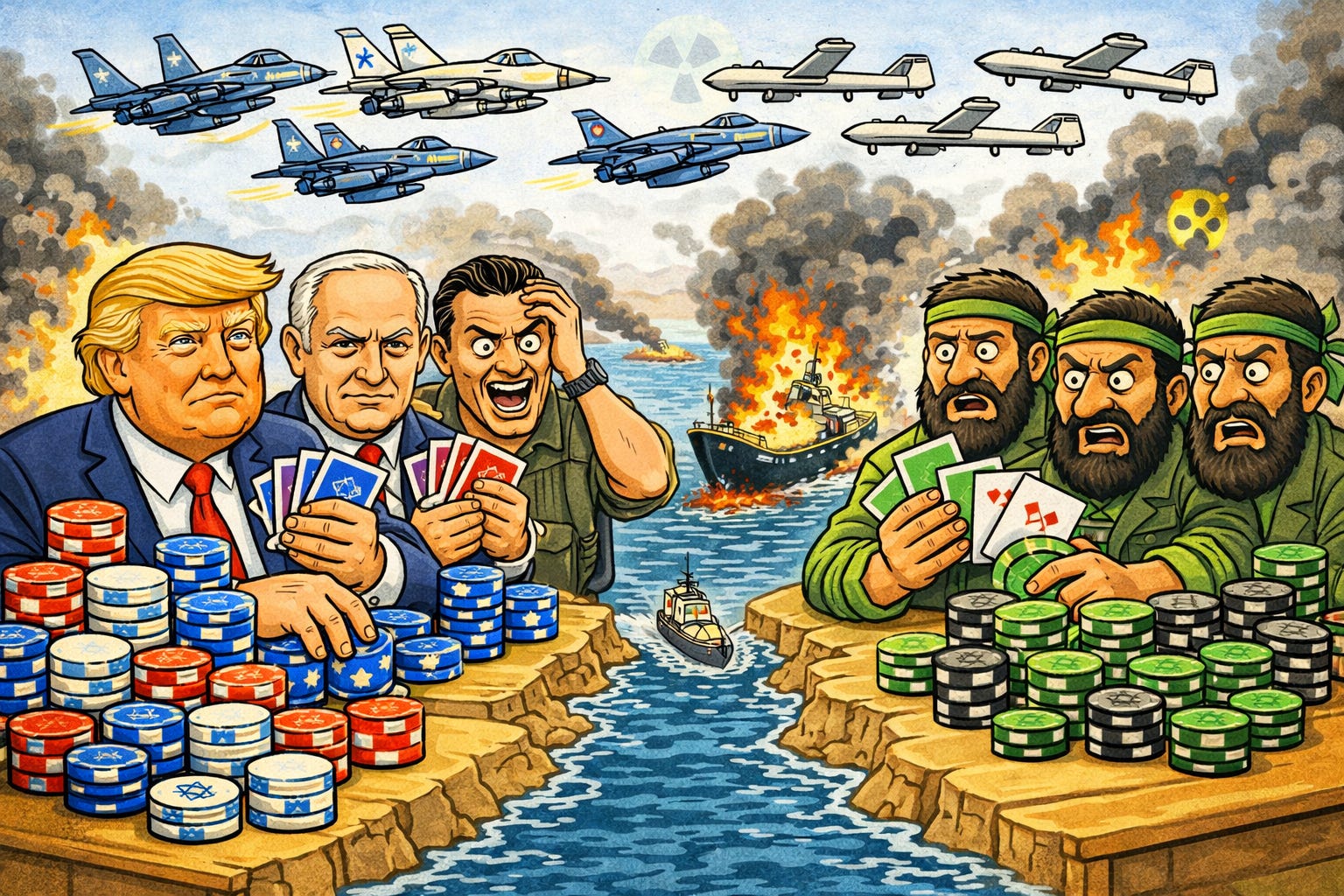
Escalation risks in the U.S.-Israel-Iran war
A game-theoretic assessment suggests the likeliest outcome is a war that gets worse without anyone quite deciding to make it so
On 28 February 2026, the United States and Israel launched the largest coordinated military strike on a sovereign state since the invasion of Iraq. In the process, they killed Iran’s supreme leader and set off a chain of events that has since closed the world’s most important oil chokepoint, sent energy prices surging, and left the global economy teetering on the edge of a supply shock with no obvious end in sight. The war is now in its fourth week. It has no agreed purpose, no exit ramp, and no clear winner. What it does have is momentum - and several tripwires that could push it from a dangerous but bounded confrontation into something far worse.
Applying a game-theoretic lens to that question, this assessment places the probability of broader regional conventional escalation at roughly 45 to 50% over the next three to six months. This scenario entails more strikes, more retaliation, a widening Lebanon front, and continued Hormuz disruption, but it still falls short of regime change or nuclear use. The prospects of a grinding but bounded war sits at 30 to 35%, a fragile externally-pressured pause at 25 to 30%, and nuclear use remains an extreme tail risk at 1 to 3%. Trump’s 23 March decision to extend the Hormuz ultimatum by five days modestly improves the odds of a temporary pause, but not of a stable settlement. The central danger is that this war now has a logic of its own — and that logic points toward escalation.
A game-theoretic approach to escalation risk
Game theory is concerned with how actors make strategic choices when the outcomes of those choices depend on what others decide simultaneously. Each actor is assumed to have a set of available strategies, a set of preferences over possible outcomes, and some degree of information about the choices and likely responses of the other parties. The theory does not require that actors always behave optimally; it does assume that they respond, at least partly, to incentives, costs, and perceived threats.
Applied to armed conflict, this lens shifts the analytical question from what is happening to why each party is making the choices it is, and what conditions would cause those choices to change. It asks: what does each party want, what can it credibly threaten or promise, what does it believe about its adversary’s resolve and internal cohesion, and under what conditions would any actor prefer to continue fighting, pause, or escalate sharply? These questions are particularly important for a conflict like this one because many of the most dangerous dynamics, including brinkmanship, deterrence failure, and inadvertent escalation, cannot be understood by looking at one actor in isolation. They emerge from the interaction among multiple parties whose choices are mutually conditioning.
The U.S.-Israel-Iran war is an unusually complex multi-player game. There are at minimum three principal belligerents, each with distinct domestic pressures, varying risk tolerances, and different time horizons for acceptable outcomes. There are also several secondary actors, including China, Russia, the Gulf states, and European governments, whose preferences and possible interventions shape the strategic environment without being fully within any single party’s control. The conflict involves both incomplete information, since each side is uncertain about the other’s true resolve, military capacity, and internal cohesion, and the persistent risk of miscalculation, where an actor misjudges how an adversary will respond to a given move. These are precisely the conditions under which game-theoretic reasoning adds the most analytical value.
This assessment uses a qualitative rather than formal quantitative version of that framework. It does not specify utility functions or compute equilibria in the strict mathematical sense; a crisis of this pace and opacity does not permit that degree of formalisation. Instead, it uses game-theoretic reasoning to structure the analysis: identifying the main players, mapping their most plausible strategies and constraints, assessing the credibility of threats and commitments, and estimating how different shock events could shift incentives across all relevant parties. The resulting probability bands reflect structured judgements calibrated against observable signals, not outputs of a statistical model.
The shape of the conflict
The U.S.-Israel-Iran conflict began on February 28, 2026 and has already become both a military crisis and a systemic economic shock. The Strait of Hormuz, through which roughly 20% of global oil flows, sits at the center of the confrontation. This assessment applies a game-theoretic lens to examine the most likely escalation pathways over the next 3 to 6 months as of March 23 2026. (1) The scenarios below are best understood as overlapping pathways rather than mutually exclusive end states. Several can unfold simultaneously or in sequence. Internal fragmentation in Iran, for instance, could emerge within a broader regional escalation, while a nuclear threshold event remains a tail risk that could be triggered by multiple different scenarios rather than arising independently. These are structured likelihood bands, not clean additive probabilities. The goal is to clarify the most plausible trajectories, flag the key tripwires, and map the spillover effects as of 23 March 2026.
Scenario probabilities
The most likely trajectory over the next 3 to 6 months is broader regional conventional escalation, which this assessment places at roughly 45 to 50%. This still falls short of regime change or nuclear war, but it represents a qualitative step up from the current baseline in both scale and geography. In this scenario, the war does not simply continue at its present intensity. It becomes bigger, harsher, and more regionally expansive. Expect more U.S. and Israeli strikes on hardened Iranian targets, more Iranian missile and drone attacks on Israel and Gulf infrastructure, continued Hormuz disruption, and a widening Lebanon front. A closure or severe disruption of Hormuz would not only affect oil and gas supply chains. It would also disrupt shipments of helium, petrochemicals, pharmaceuticals, fertilizers, and food supplies, with wider global spillover effects. The risk is elevated because the war is now in its fourth week, public reporting indicates more than 16,000 targets have been struck, Iranian retaliatory strikes have reached areas near Dimona and Arad, and attacks on water and electricity systems are increasing the scope for reciprocal infrastructure warfare. The U.S. has also reportedly deployed 4,500 marines to the region. The White House appears to have softened the timing of threatened strikes without clearly stepping back from the capability to escalate quickly. Washington may have stepped back from immediate action, but it has not stepped back from escalation dominance or from preserving military options in theater.
The second most likely scenario is a grinding but still bounded war, at roughly 30 to 35%. This differs from the first scenario in that the conflict remains intense but does not decisively widen into a broader regional campaign. Israel continues striking Iranian military, proxy, and dual use targets; Iran sustains missile, drone, cyber, and maritime pressure; and Washington alternates between coercive threats and selective restraint. This remains plausible because U.S. behavior still looks more consistent with short, visible bursts of force than with a disciplined, open-ended campaign, even as deployments and escalatory signaling continue. Discussion of U.S. special forces, marines, shipping escorts, and insurance backstops may signal planning for limited coercive control missions around chokepoints, but these steps are more likely to increase operational friction and miscalculation risk than to provide a durable solution.(2)
Third is an unstable freeze or partial pause, at roughly 25 to 30%. This would not be a genuine peace settlement. It would look more like exhaustion under pressure, with some reopening of Hormuz, a lower tempo of long range strikes, renewed mediation, and public declarations of success by all parties. The pressure for such a pause comes as much from outside the battlefield as from within it. Beijing and Washington both have strong reasons to avoid a prolonged conflict, even if they approach the crisis from different strategic positions. Moscow, by contrast, benefits from sustained energy disruption and higher prices, an odd strategic disjuncture among the major powers. Europe’s interest is overwhelmingly in de-escalation and economic containment, not an escalatory coalition. (3) Gulf states want direct strikes on critical infrastructure halted, and exposed Asian economies such as Japan, India and South Korea need to contain inflationary and growth shocks. The sheer scale of energy disruption raises the incentive for a pause, even where the political conditions for a stable settlement remain weak. (4) Trump’s March 23 decision to extend the Hormuz ultimatum by five days and suspend threatened attacks on Iranian power plants modestly strengthens this scenario. The existence of informal regional intermediaries, including reported messages passing through Turkey, Egypt, and Pakistan, suggests that the current opening is more than rhetorical, but it is still better understood as a tactical pause inside a coercive bargaining cycle than as evidence of a durable diplomatic breakthrough.
A short, sharp regime targeting campaign sits at roughly 6 to 10%. It would most likely be triggered by a major shock, such as a sustained Hormuz closure despite U.S. ultimatums, mass U.S. casualties, a successful strike on a major U.S. naval platform, a major Iran linked terrorist attack, or compelling evidence of Iranian nuclear breakout. This is still not the base case. U.S. allies remain reluctant to join a wider war, and Washington itself appears divided between coercion and exit. (5) The war already features public threats to devastate core Iranian infrastructure, reported use of heavy ground penetrating bunker buster ordnance, discussion of limited U.S. force deployments around chokepoints (e.g. Kharg island), and an escalation ladder that now clearly includes strikes on hardened underground targets. That does not mean a move to non-strategic nuclear weapons is likely, but it does mean the conflict has already climbed into a more dangerous band of military signaling.(6)
A fifth scenario is internal breakdown or fragmentation in Iran, placed at roughly 4 to 8% over a 3 to 6 month horizon. This would not necessarily take the form of externally imposed regime change. Rather, it would involve severe internal destabilization driven by cumulative military losses, leadership decapitation, fragmentation within the security apparatus, and worsening social or sectarian tensions. If Washington actively supports insurgent activity inside Iran, including through Kurdish militias, the more likely result would be not a clean collapse of the regime but a sharper and more fragmented conflict that strengthens hardliners in the short term, intensifies repression, and raises the risk of spillover into Iraq and neighboring states. In that case, Sunni Shia tensions could sharpen inside Iran and reverberate across Bahrain, Kuwait, Saudi Arabia, and Pakistan, producing a second order regional crisis layered on top of the war itself. This remains a secondary scenario because the Iranian state has shown significant resilience under extreme pressure, but active destabilization efforts make internal fragmentation more plausible than a lower baseline might suggest.(7) Such efforts are more likely to intensify repression and fragmentation than to produce a clean transition.
The lowest probability but highest consequence scenario remains nuclear use or a catastrophic nuclear threshold event, placed at roughly 1 to 3% overall over a three-to-six month horizon. Deliberate U.S. first use remains below 1% given conventional alternatives, but Israeli first use is a more serious outer bound risk if Israeli leaders conclude they face a genuine existential breakdown. Recent reporting describes missile strikes near Dimona and explicit Iranian threats involving Israel’s nuclear infrastructure, which increases the salience of this scenario even if it does not make first use likely today. Israel is still far from exhausting its conventional options, and there is no public evidence that it is preparing to cross the nuclear threshold now. But Israel’s opaque nuclear posture is widely understood as a last resort survival hedge rather than a warfighting doctrine, so the key issue is not routine escalation but whether decision makers begin to believe that conventional defenses can no longer guarantee state survival. The March 23 shift toward temporary bargaining does not materially reduce this risk, particularly due to Natanz attack, Dimona-related signalling, and ongoing attacks on strategic infrastructure. The concern here is less routine nuclear escalation than the possibility that repeated strikes on sensitive sites and worsening perceptions of vulnerability push decision makers toward last-resort logic.
Scenario probabilities as of 23 March 2026 6
The nuclear file
The nuclear file nonetheless remains central to all these scenarios The IAEA reported that Iran had accumulated 440.9 kg of uranium enriched up to 60% U-235 by the time of the 2025 military attacks, and verification of that inventory lapsed after inspectors were withdrawn for safety reasons. That does not mean Iran definitely has a bomb within weeks, but it does mean breakout concerns remain serious enough to keep preemption pressure alive in both Washington and Jerusalem. In practical terms, the nuclear issue raises the ceiling of the war even if it does not make nuclear use likely. It sharpens Israeli threat perceptions, sustains incentives on both sides to consider further strikes on hardened nuclear related targets, and increases the risk that misperception, panic, or a last resort survival logic could push the conflict across a far more dangerous threshold. (8) It also raises the likelihood of limited special forces use for reconnaissance, site exploitation, battle damage assessment, or control of especially sensitive nodes if air strikes are judged insufficient.
US domestic politics and escalation pressure
U.S. domestic politics make the forecast more unstable in ways that are difficult to model cleanly. Weak political standing and the November midterms likely reduce tolerance for a long, inflationary war, but they also increase the incentive for visible, discrete demonstrations of resolve that can be packaged as success. This dynamic may be reinforced by competing priorities closer to home - Cuba, Nicaragua, Colombia, Greenland, Canada. If the White House sees the Middle East as a distraction, the temptation will be to pursue a fast, high-visibility military outcome that can be declared a victory and handed-off to others to manage. That points to shorter decision horizons, a higher appetite for symbolic force, and lower appetite for prolonged entanglement. Domestic pressure is therefore more likely to generate abrupt escalation spikes than clean restraint. Trump’s long standing aversion to nuclear weapons may act as a modest brake on deliberate nuclear use, but it does not materially reduce the risk of heavy conventional escalation.
Domestic politics in both Israel and Iran push toward harder outcomes for different but structurally parallel reasons. For Israel, the war is being experienced as immediate and existential. Iranian strikes are reaching southern areas near sensitive nuclear linked sites, and operations are widening into Lebanon. For Iran, the war also looks existential: U.S. and Israeli leaders have threatened devastating retaliation and implied regime crippling goals. Iran has clearly been degraded by sustained strikes and leadership losses, but the structure of the IRGC suggests that hardliners remain resilient and decentralized command networks retain significant missile, drone, and sea denial capacity. Heavy losses have not produced capitulation. They may instead have reinforced the leadership’s conviction that continued resistance and leverage over Hormuz are politically necessary for survival.
Both sides are therefore, in game-theoretic terms, in a situation where the domestic cost of appearing to back down may exceed the strategic cost of continued escalation. That is precisely the condition under which coercive bargaining becomes most dangerous: neither party can accept a settlement that looks like defeat, and neither can credibly commit to restraint without risking internal legitimacy.
Tripwires and tail risks
What makes this war genuinely dangerous is not the baseline trajectory but the presence of tripwires that could sharply shift the distribution of outcomes. The conflict is no longer a smooth bargaining process. Certain shocks could rapidly shift it into a far more severe phase: Iran or a proxy hitting a U.S. aircraft carrier or causing mass U.S. casualties; a terrorist attack on U.S. interests credibly linked to Tehran; a prolonged failure to reopen Hormuz despite U.S. ultimatums; or a strike on a reactor or nuclear related site generating meltdown or radiological release fears. These are low frequency events, but their impact would be disproportionate. Conditional on any one of them occurring, the probability of a sharp U.S. Israeli punitive campaign rises substantially. The same holds for direct U.S. force deployments around maritime chokepoints, which create more contact points and hence more opportunities for escalation by miscalculation rather than by deliberate decision.
Concentric circles of risk
The final layer of analysis concerns the concentric circles of risk that surround the core confrontation. The inner circle is the Israel, Iran, and U.S. battlefield. The next is the Gulf and eastern Mediterranean. The third is the global energy and trade ring, where China is the pivotal actor. As one of the largest end markets for Gulf oil, Beijing has a strong interest in rapidly restoring Hormuz flows and may be one of the few outside powers with real leverage to press Tehran toward a partial reopening. The outer circle takes in Europe and NATO, where any major Middle East escalation intersects with the still active Russia Ukraine war, alliance force posture, missile defense readiness, and political cohesion. Europe is more likely to support containment, maritime security, and crisis management than a wider escalatory coalition. China is more central to any unstable freeze because of its role in energy demand, trade stability, and diplomatic leverage. Russia, by contrast, has stronger incentives to see a longer conflict if that sustains energy disruption and weakens Western strategic focus.
One further assumption underlying this entire assessment deserves explicit qualification. The model assumes that most decision-makers are broadly responsive to costs, deterrence, and strategic incentives. That assumption may be complicated by the influence of eschatological, messianic, or apocalyptic worldviews among some political, military, and clerical factions in all three principal belligerents. In the U.S., recent scrutiny of senior officials has highlighted the growing visibility of Christian nationalist and providential rhetoric in parts of the national security establishment. In Iran, there are Mahdist currents among segments of the regime’s hard-core base and the IRGC orbit. In Israel, religious nationalist and messianic strands have become more visible in the wider political climate surrounding existential war. These currents do not displace standard strategic logic, but they can complicate a rational utility model by increasing tolerance for risk, reframing sacrifice as redemptive, and making compromise harder when actors interpret the conflict in civilisational or prophetic terms rather than only material ones. A game-theoretic framework that does not account for this dimension will systematically underestimate the probability of choices that appear strategically irrational but are internally coherent within a different normative frame.
Driver matrix as of 23 March 2026
*Score is a qualitative weight from 1 = minor influence to 5 = dominant influence.
Conclusion
The game-theoretic framing of this conflict yields a conclusion that is both more precise and more disturbing than a simple narrative account would suggest. The most probable outcome is not peace, not decisive victory, and not catastrophic nuclear escalation. It is a war that gets worse in familiar ways: harder conventional strikes, wider geographic scope, deeper economic disruption, and a gradually degrading set of conditions for any negotiated pause. The modal scenario, broader regional conventional escalation at 45 to 50%, describes a conflict that continues to intensify without crossing into a new category of violence. That is cold comfort. A war that stays conventional can still destroy economies, destabilise governments, and produce cascading humanitarian consequences across the region and beyond.
The deeper insight from applying a game-theoretic lens is structural. All three principal belligerents are trapped in a coercive bargaining dynamic in which the domestic cost of being seen to concede may now exceed the strategic cost of continued escalation. That is the condition under which wars prolong themselves even when all parties would, in the abstract, prefer a settlement. None of the three can accept a pause that looks like capitulation to their domestic audiences; none can make a binding commitment to restraint that their adversaries would find credible; and each has incentives to use the next round of military action to improve their bargaining position before any talks begin. Trump’s 23 March extension is best read within that logic: it is not evidence of a diplomatic breakthrough but of a bargaining cycle that has not yet found its floor.
What the analysis cannot resolve is when and whether any of the identified tripwires will fire. A carrier strike, a reactor incident, or a mass-casualty event could shift the entire probability distribution within hours. The driver matrix shows a system under extreme stress, with nearly every escalation driver running at high or very high levels and only limited countervailing pressures from allied reluctance, European preferences for restraint, and external economic coercion. The window for a durable pause exists, but it is narrow, contingent on intermediaries that lack enforcement capacity, and vulnerable to a single shock event that forecloses it. Policymakers seeking to reduce escalation risk should therefore focus less on the diplomatic track, which is real but fragile, and more on reducing the probability of the tripwire events themselves: protecting high-value military assets from opportunistic attack, maintaining deconfliction channels around sensitive nuclear sites, and sustaining economic pressure on all parties to keep the incentive for a partial pause alive. The game is still in play. But the margin for error is shrinking.
Annex: A Note on Methodology
This assessment draws on a qualitative game-theoretic risk model combined with scenario analysis. It treats the war as a multi-actor coercive bargaining game under uncertainty, in which the United States, Israel, and Iran are each seeking to improve their strategic position while also managing battlefield realities, domestic politics, alliance pressures, economic shocks, and perceived red lines. The model is designed to do three things: identify the most plausible escalation pathways over a three-to-six-month horizon, estimate likelihood bands for each, and distinguish central scenarios from tail risks. It assumes that most actors behave broadly strategically, while also allowing for misperception, organisational fragmentation, ideological constraint, and accidental escalation, all of which can push outcomes well beyond what a simple rational utility-maximising model would predict.
Methodologically, the assessment combines structured judgement, escalation ladder analysis, and comparative scenario weighting. The scenarios are treated as overlapping rather than mutually exclusive: internal fragmentation, external escalation, and nuclear threshold risks can emerge in parallel or in sequence. The analysis is grounded in open-source reporting, including major international media; official statements from the White House, Pentagon, NATO, and foreign ministries; technical reporting from the International Atomic Energy Agency; energy market analysis from the International Energy Agency; prediction market data (9); and publicly available assessments of military posture, force deployments, political rhetoric, shipping disruption, and macroeconomic spillovers. These sources anchor the probability bands but cannot substitute for the granular internal intelligence available to national security agencies or military planners.
A more rigorous assessment could deploy formal non-cooperative game models, Bayesian updating, agent-based simulations, crisis instability models, or Monte Carlo scenario testing that iterates across thousands of combinations of shocks, responses, and signalling failures. These approaches would allow for more explicit treatment of incomplete information, sequencing effects, and cross-theatre interactions. Even so, they would still depend heavily on the quality of underlying assumptions, particularly around leadership psychology, clandestine action, and regime resilience. Analytical sophistication is no substitute for good inputs.
Three blind spots deserve particular attention. The model cannot directly observe private signalling, covert operations, leadership psychology, or hidden diplomatic bargains, the very variables that most often determine how crises break. It depends on public reporting that may be incomplete, politicised, or overtaken by events faster than any open-source assessment can track. And it is most vulnerable precisely where the stakes are highest: misperception inside decision-making circles, concealed military degradation or unexpected resilience, and ambiguous shock events that can suddenly dominate outcomes with little warning.
Endnotes:
(1) This assessment uses a qualitative game theoretic risk model combined with scenario analysis. It treats the conflict as a multi-actor coercive bargaining game under uncertainty and estimates overlapping likelihood bands based on strategic interaction, escalation dynamics, domestic politics, external pressures, and tripwires, rather than as a formal statistical forecast or a set of mutually exclusive outcomes.
(2) Prediction market pricing also points in this direction. It implies a meaningful probability of some form of U.S. force entry or narrow ground involvement, but not necessarily a full regime change campaign, while simultaneously assigning a rising chance of a ceasefire over the coming months. That combination is more consistent with bounded escalation followed by pressured bargaining than with either immediate de escalation or open ended occupation.
(3) A sectoral pause such as a maritime arrangement around Hormuz or tacit limit on energy and civilian infrastructure strikes and deconfliction channel related to nuclear facilities are more likely than a peace settlement or even a ceasefire. The EU is reportedly actively exploring such options, analogous to the Black Sea grain deal. China is likewise pushing for mediation. However, none of these countries offers enforcement guarantees and Europe has explicitly declined joining militarily while the war continues.
(4) A further possibility within this scenario is a ‘declaration of victory’ variant, in which Washington uses heavy punitive force, leadership decapitation, and symbolic coercion to claim strategic success, then shifts the burden of stabilization onto regional actors and allies while refocusing on priorities closer to the Western Hemisphere. In that case, the result would be less a coherent regime change campaign than a violent but strategically incomplete outcome, with the United States disengaging before the political and security consequences inside Iran have been resolved.
(5) But it has become more plausible following the March 20 ultimatum to reopen the Strait within 48 hours and explicit threats to destroy major Iranian power infrastructure if Tehran refuses.
(6) The March 23 postponement issued by Trump lowers the immediate probability of this scenario relative to the 48 hour ultimatum phase, but it leaves the option very much alive if talks fail or if Iran continues to challenge Hormuz after the extension expires.
(7) The March 23 diplomatic pause issued by Trump does little to change this structural risk, especially as infrastructure attacks, repression, and leadership attrition continue.
(8) It also raises the probability of limited special forces use, not for a large occupation, but for reconnaissance, targeting support, battle damage assessment, site exploitation, or temporary control of especially sensitive nodes if U.S. leaders conclude that air strikes alone cannot manage the breakout risk or secure key chokepoints.
(9) Prediction market data, including Polymarket contracts on U.S. force entry into Iran and ceasefire timing, can help sharpen the timing signal in this assessment, but they should be treated as secondary indicators rather than as the base model. Market prices are useful as crowd weighted sentiment measures, especially for near term escalation and bargaining expectations, but they are sensitive to contract wording, liquidity, and rapidly changing headlines.
The Risk Ahead
SecDev’s geopolitical risk practice - builds on three decades of fieldwork across 120+ countries industrialized into on-demand strategic advantage. The era of treating geopolitical risk as an externality is over. Supply chains now span hostile borders, critical technologies depend on adversarial states, and market access hinges on diplomatic whims. What was once the domain of foreign ministries has become every CEO’s problem. SecDev’s Intelligence as a Service delivers tiered, contract-free engagement: from real-time assessments that move faster than markets to deep-dive analysis that uncovers the networks and contacts buried in geopolitical complexity. The question isn’t whether geopolitical shocks will hit your business - it’s whether you’ll see them coming.
SecDev AI
SecDev AI delivers first-in-class Data as a Service AI solutions combining highly trained models with unique, curated datasets. Our next-generation, precision-built expert systems meet the most demanding requirements. By integrating data curation with advanced machine learning, we provide specialized tools that deliver actionable insights where accuracy and reliability are paramount.