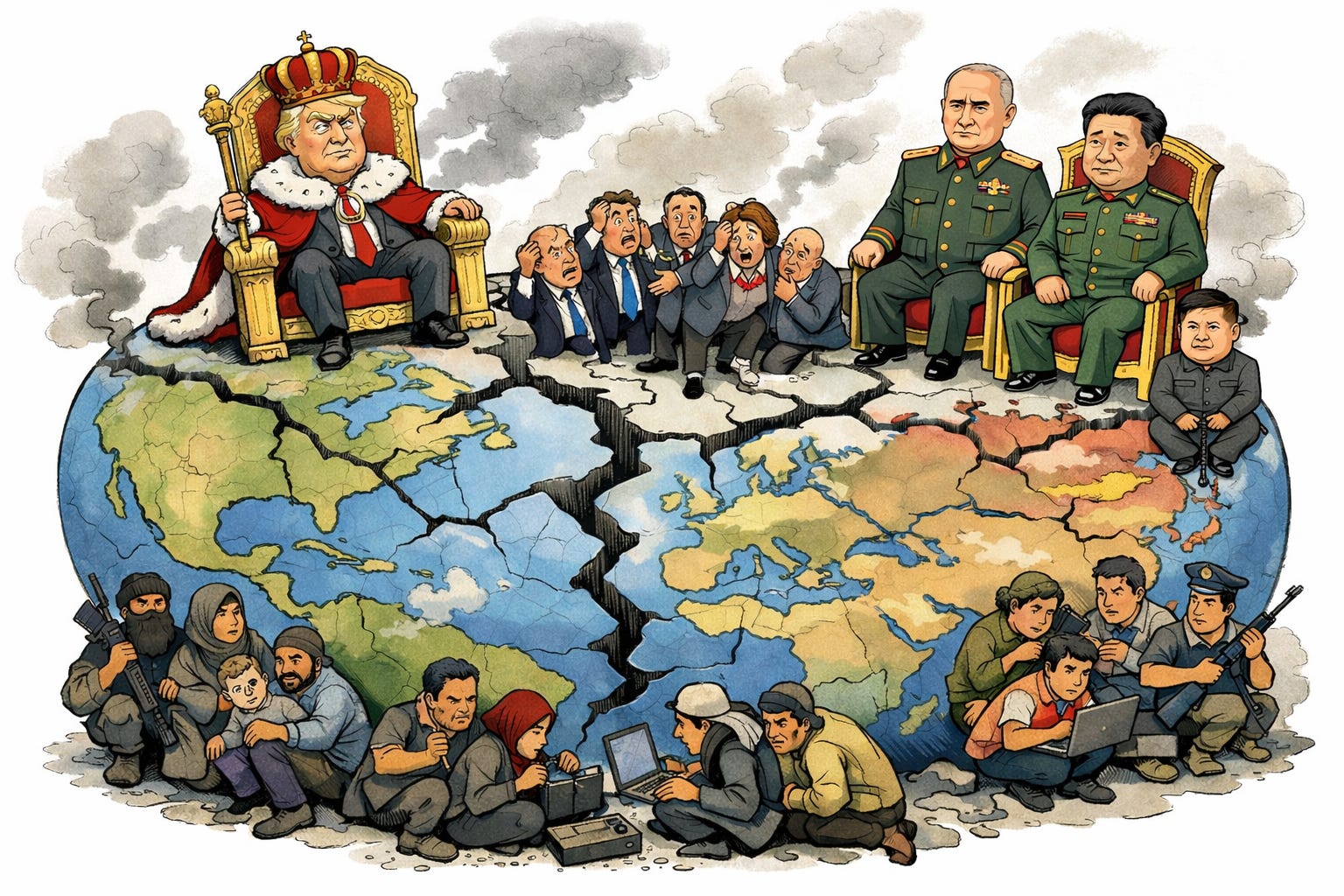
Disorder, Inc.
The rules-based order is fraying. What comes next is up for grabs
Since the end of the Cold War, globalization was sold as a positive-sum game. Trade would bind rivals together, capital would flow freely, technology would shrink distances, and multilateral institutions would police the edges. That story is over. We are back in a spheres-of-influence world —one increasingly divided between the United States, Russia and China—with other powers manoeuvring in the seams.
The world is slipping into an “age of disorder” in which the U.S.-led unipolar order has faded but no stable multipolar equilibrium has taken its place. The current global landscape is increasingly fractured, with overlapping geopolitical, economic, environmental and technological shocks. Yet gloomy as the headlines are, if governments, firms, and citizens can rethink the rules of interdependence, update institutions and build resilience, a disordered age need not harden into an age of permanent dysfunction.
Has globalization started to turn against itself?
What distinguishes this era from the previous one is not only greater uncertainty and tension, but the weaponization of economic, financial, and even digital interdependence. The 2026 Global Risks Report shows that geoeconomic confrontation has become a central organising principle of great-power rivalry. Sanctions, tariffs, export controls, investment bans, and the weaponization of the financial system now rank among the top three global risks over the next two years, alongside state-based armed conflict and extreme weather. The aim is no longer simply to maximize welfare in a benignly interdependent world; it is to secure advantage and impose costs in a fragmenting one.
At the root of this shift lies the end of American predominance without the birth of a stable successor order. The U.S. remains powerful, but no longer enjoys uncontested primacy. China has risen; India, the European Union, Gulf monarchies, Brazil and others are more willing to chart their own course. Yet there is no shared design for a cooperative multipolar system. Indeed, the latest U.S. National Security Strategy charts a radical new direction from the rules-based order Washington once championed. What is emerging instead is a variable geography of overlapping spheres of influence, ad-hoc coalitions and transactional alignments. In this limbo, trust is scarce and the temptation to reach for coercive economic tools is high.
What’s driving fractured governance and fragile societies?
Domestic politics are amplifying these trends. The Forum’s risk report describes what amounts to a rule-of-law and governance recession. Checks and balances weakening in many democracies and autocracies alike, and political polarization making compromise into a dirty word. Independent media and civil society face mounting pressures. Young people, facing stagnant prospects and feeling excluded from opaque decision-making, are taking to the streets. From South Asia to Latin America and Africa, “street versus elite” movements have toppled governments or forced abrupt policy reversals. Leaders often respond with violent crackdowns or performative nationalism, trading long-term cohesion for short-term control.
Economic conditions compound the strain. Years of ultra-loose monetary policy, followed by an inflation spike and higher interest rates, have left many governments in a fiscal bind. Debt burdens have swollen even as demands on the state - for welfare, defence, climate adaptation and industrial policy - keep rising. The 2026 Risk Report warns of “supercharged economic tensions” as countries resort to subsidies, export controls and industrial policy to re-shore or “friend-shore” or “near-shore” production. Ageing populations in rich countries and slowing growth in some emerging markets limit the room for manoeuvre. In this environment, subsidy races and protectionist measures feel politically irresistible, even if they undermine the global growth needed to service debts.
Are sanctions and subsidies the new weapons of war?
Climate change and technological upheaval add further uncertainty. AI, quantum computing, advanced robotics and biotechnology are becoming both sources of economic promise and objects of genuine fear. Controls on high-end chips, quantum hardware and sensitive data are sold as national security necessities but rivals see them as acts of economic warfare. Digital technologies also make information itself a battlefield as deepfakes, bots, and targeted disinformation campaigns corrode any shared sense of reality turning every election, protest or crisis into a contest over facts. Meanwhile, extreme weather is disrupting supply chains, straining power grids and worsening food and water insecurity.
Trade and global value chains are undergoing their most significant disruption in decades. The World Trade Organization’s dispute-settlement system has been in crisis since its Appellate Body ceased to function in 2019, leaving many cases in limbo and forcing countries into ad-hoc arrangements. Trade routes that once symbolized mutual gain are increasingly treated as choke points. Repeated Houthi attacks on shipping in the Red Sea and threats to Black Sea grain corridors have rerouted vessels, driven up insurance and freight costs, and raised questions about the resilience of maritime trade. Dependence on a rival for rare earths or semiconductors looks less like comparative advantage and more like a hostage situation. Governments and firms are under pressure to diversify supply chains even when alternatives are costlier. Ports, rail lines and shipping lanes are treated as strategic assets to be courted, fortified or, in extremis, sabotaged.
What happens when financial and digital networks become battlegrounds?
The financial system, too, is becoming a field of struggle. The dominance of the dollar and Western banking infrastructure gives U.S. and its allies enormous leverage. They can freeze central-bank reserves, bar firms from using the global payments system and deter investors with the threat of secondary sanctions. The freezing of hundreds of billions of Russia’s reserves after the invasion of Ukraine illustrates the scale of this power. These tools have real bite and irresistible appeal. But their repeated use encourages targeted states to seek workarounds, from alternative messaging systems and bilateral swap lines to a rapid expansion of dollar-pegged stablecoins and crypto-assets as well as louder calls for “de-dollarization”. The IMF and Financial Stability Board have warned that widespread adoption of foreign-currency stablecoins in emerging markets can erode monetary sovereignty and complicate macroeconomic management.
Digital interdependence is equally double-edged. On the one hand, undersea cables, cloud providers, and satellites knit economies together, but they are also exquisite vulnerabilities. Across Europe and beyond, cyber attacks on grids, pipelines, hospitals or air-traffic systems are now a routine feature of confrontation. Espionage and sabotage can be deniable and continuous. Meanwhile, biometric databases and digital identity systems determine who can access jobs, credit and public services. In the wrong hands they become instruments of exclusion and control, especially when fused with AI-enabled surveillance and opaque “social credit” scoring. Decision-makers are also increasingly concerned that heavy reliance on software, platforms and satellite networks controlled by a handful of powerful states and firms can be leveraged as a geopolitical kill switch, with access to cloud services and critical connectivity threatened or withdrawn if governments refuse to align their policies or sever ties with rival powers.
Can any country manage systemic risk on its own anymore?
The impacts of this intensifying competition are multiplying. In the short term, households and firms feel it through more volatile prices, more frequent disruptions and slower growth. Energy and food markets lurch when pipelines are blown up or grain corridors close. Export controls on critical technologies spur retaliatory measures, sapping investment. Subsidy races divert scarce fiscal resources towards favoured sectors while leaving basic services underfunded. As public debts mount and confidence wobbles, the risk grows that a sudden reassessment of asset values – say, in over-hyped AI stocks or in the opaque world of private credit – could trigger a broader financial shock.
Politically, societies are fraying. The combination of rising populism, economic stress, cultural polarization and organized disinformation make compromise harder, pushing parties towards extremes. Central banks are coming under pressure to finance governments or keep rates low regardless of inflation, raising the spectre of financial repression. Military spending is eclipsing all records. Citizens, bombarded by conflicting narratives and sensational images of violence, risk becoming desensitized to distant suffering. Conflicts that might once have provoked outrage instead blend into the background noise. That, in turn, lowers the perceived cost of military adventurism.
Over the longer run, structural risks are mounting. Labor markets could face severe dislocation as AI and robotics automate both white- and blue-collar tasks faster than education and training systems can adapt. Governments are flirting with universal basic income or job-guarantee schemes without resolving how to pay for them in fiscally constrained conditions. Large cohorts of under-employed young men, adrift and resentful, are cannon fodder for populists and war-makers alike. Artificial general intelligence (AGI) and quantum computing, if and when they mature, threaten to break today’s cryptographic systems (and much more), unsettling trust in everything from online banking to state secrets. A small club of states and firms would wield extraordinary informational and economic power over others.
How do we harden societies without closing them?
Faced with this forbidding landscape, fatalism is tempting. It would also be wrong. The same risk assessments that catalogue the dangers also sketch a set of pragmatic, if politically demanding, responses.
The first is to accept multipolarity while defending multilateralism. A more plural distribution of power need not mean the end of rules; indeed, it makes agreed rules more necessary. That argues for reform rather than abandonment of institutions such as the United Nations, the international financial architecture and regimes governing trade, climate and health. Rising powers must be better represented; established powers must accept that representation. In parallel, flexible coalitions of willing states can advance cooperation on specific issues from pandemic preparedness to AI safety without requiring universal agreement.
Second, governments need a doctrine of responsible economic statecraft. Sanctions, export controls and industrial policy are sometimes justified. But without guardrails they can become self-defeating. Minimum standards might include clear objectives and exit criteria; coordination with allies, transparency about humanitarian carve-outs, and a presumption in favour of measures that build resilience (such as diversification and stockpiling) over those that simply coerce. The financial and payments infrastructure that underpins global commerce should be treated less as a convenient cudgel and more as a shared utility.
Third, states must invest in anticipatory governance. That means strengthening foresight units, commissioning stress-tests not only for banks but also for infrastructure, supply chains and social systems, and giving statistical agencies and regulators the independence to resist political manipulation. It calls for serious scenario-planning around AI, crypto-assets, quantum computing and climate tipping-points, so that rules are shaped upstream rather than in panic once a crisis erupts. Central banks, competition authorities and data-protection bodies will increasingly sit at the heart of geopolitical risk management as well as economic stewardship.
Finally, resilience has to be built from the local level up. National strategies and global compacts matter, but shocks are absorbed (or not) in neighbourhoods, towns and cities. Investments in reliable energy grids, water systems, health networks and digital access can reduce the damage of both climate-related disasters and deliberate disruption. Targeted social protection, inclusive education and space for civic organising can blunt the appeal of extremism. Empowering local authorities and communities, while connecting them to international support and knowledge, is one of the few ways to make an age of disorder survivable.
Globalization will not be rewound since too many ties are now sunk into the world’s operating system. But interdependence can be managed more wisely. The choice is not between a nostalgic return to the 1990s and a fatalistic plunge into zero-sum rivalry. It is between letting the emerging global “system” consolidate as a hard-edged contest of geoeconomic coercion inside overlapping spheres of influence, too often framed by Washington’s renewed embrace of a might-is-right posture, visible in its National Security Strategy and in recent ventures and threats directed at Venezuela, Cuba, Colombia, Greenland, Canada, Iran and others or using this disordered moment to rebuild constraints, restore bargaining space, and make economic statecraft less incendiary. The alternative is clear: letting the new age of disorder harden into permanent dysfunction, or using it, arduously, to build a risk-aware, plural and still cooperative order.
Robert Muggah is co-founder and principal of the SecDev Group and co-founder of the Igarapé Institute, a Brazilian think tank ranked the world’s top social policy organisation in 2019. A political economist with a doctorate from Oxford, he has spent two decades advising governments, the UN, the World Bank and the Inter-American Development Bank on public security and organised crime across more than 50 countries.
SecDev’s geopolitical risk practice - builds on three decades of fieldwork across 120+ countries industrialized into on-demand strategic advantage. The era of treating geopolitical risk as an externality is over. Supply chains now span hostile borders, critical technologies depend on adversarial states, and market access hinges on diplomatic whims. What was once the domain of foreign ministries has become every CEO’s problem. SecDev’s Intelligence as a Service delivers tiered, contract-free engagement: from real-time assessments that move faster than markets to deep-dive analysis that uncovers the networks and contacts buried in geopolitical complexity. The question isn’t whether geopolitical shocks will hit your business - it’s whether you’ll see them coming.