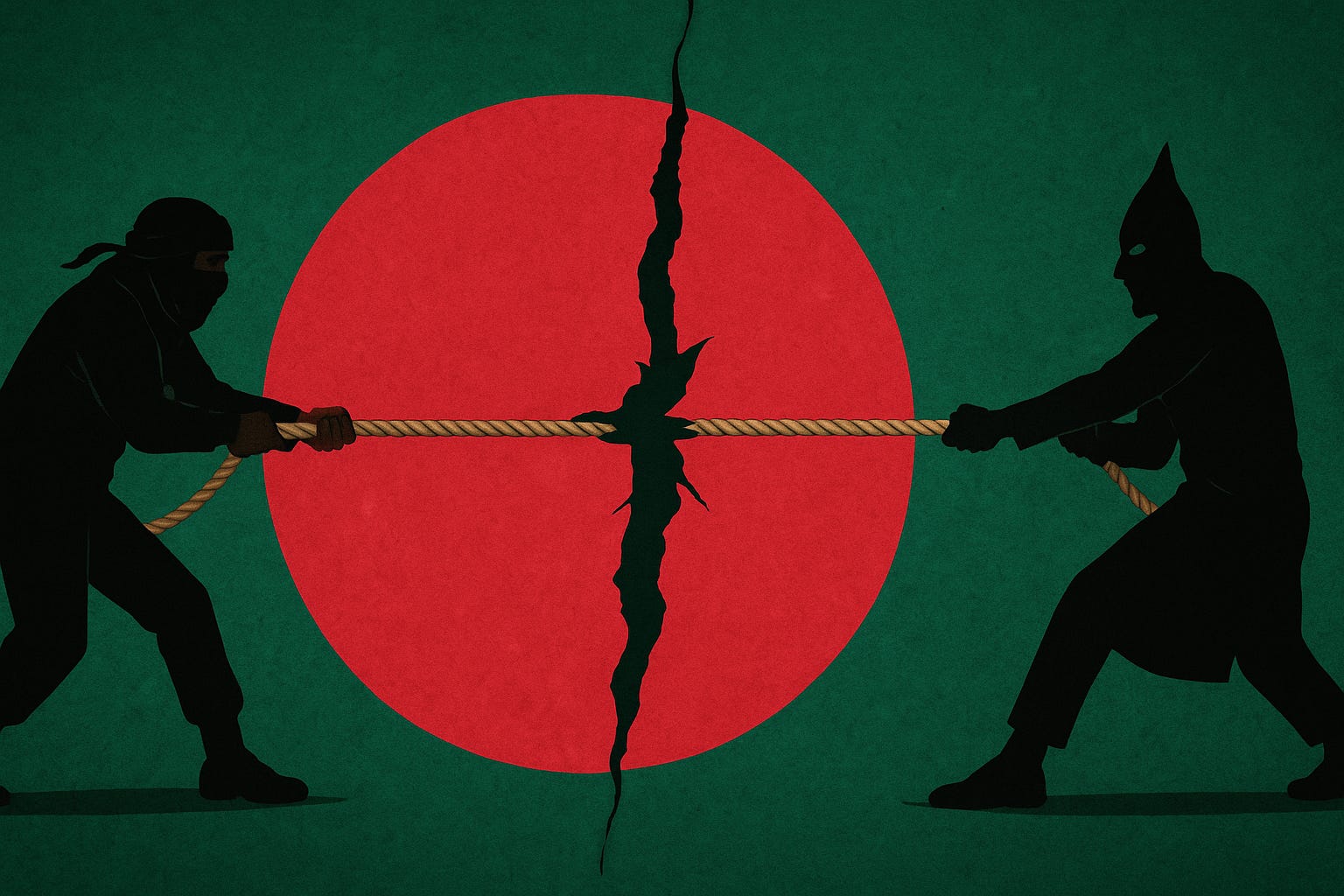
Bangladesh's Far-Right Problem: When Voting Means Voting Against God
SecDev's latest research shows that in Bangladesh, the ballot box has become a battleground for the soul.
History rarely announces when it is shifting gears. But Bangladesh’s upcoming 2026 election carries the unmistakable weight of a turning point, one where the outcome will determine not merely which party governs, but whether democratic governance itself survives. The religious far-right, largely comprising actors sympathetic to or directly affiliated with violent extremist organizations, has gained significant follower-ship by asking Bangladeshis to do something unprecedented: vote against democracy itself.
The irony is not lost on close observers. These movements are exploiting the tools of democratic participation (rallies, social media campaigns, voter mobilization) to delegitimize the very system that enables their participation. This is not political opposition in any conventional sense. It is ideological sabotage dressed in the language of religious authenticity, deploying takfiri theology to brand democratic participation as apostasy and positioning the ballot box as a sin rather than a right.
When violent extremist influencers commanding over 30 million combined subscriptions across online platforms declare that casting a ballot renders a Muslim an infidel, we are witnessing something qualitatively different from political competition.
The scale of this challenge is measurable. SecDev’s analysis of 1,638 fact-checking articles from June through October 2025 reveals a misinformation ecosystem saturated with fabricated claims, synthetic media, and AI-generated deepfakes designed to manipulate political perception. Over 515 articles referenced AI-generated or digitally manipulated content, including synthetic videos, face-swaps, and deepfake audio targeting political leaders with speeches they never gave and events that never occurred. Meanwhile, extremist networks have been systematically framing democracy as religiously impermissible, labeling all political parties (including Islamist ones) as infidel, and glorifying Taliban, AQIS, and TTP models as authentic alternatives to constitutional governance.
What makes Bangladesh particularly vulnerable is its demographic reality. With approximately 47 percent of citizens under the age of 25, an estimated thirteen to fifteen million voters will cast ballots for the first time. Their political outlook has been shaped not by party patronage networks but by digital media, with more than 60 million active social-media identities nationwide, including 64 million users reachable on Facebook and 56 million adults on TikTok. In this environment, political meaning is constructed through digital performance rather than verified information. Street mobilization is demonstrated through recycled footage. Institutional legitimacy is fabricated through edited photocards mimicking trusted news outlets. Memory of the July 2024 killings is contested through miscaptioned videos and synthetic content designed to rewrite responsibility.
The regional stakes could not be higher. Bangladesh exists within a geography already gripped by cascading instability. The permanent crisis in neighboring Myanmar has generated the largest migrant flows in the region, with over a million Rohingya refugees encamped in Cox’s Bazar. A growing crypto-criminal economy threatens to subvert legitimate political authority across South Asia’s porous borders. Into this volatile mix, the prospect of democratic collapse in one of the world’s most populous Muslim-majority nations carries implications that extend far beyond Dhaka.
The extremist strategy is coherent even if its ultimate success is uncertain. The messaging blends long-form theological justifications with highly shareable memes and short-form content designed to suppress turnout, deepen polarization, and redirect political frustration into anti-state sentiment. Their framing of Bangladesh’s democratic history as inherently illegitimate, using selective historical interpretation to argue that every political system the country has experienced has failed Muslims, creates a totalizing narrative where rejection of electoral participation becomes not just permissible but religiously mandatory.
The coming months will be defined not only by party competition but by the broader struggle to shape information flows, public memory, and political legitimacy itself.
What distinguishes this moment is the convergence of high-velocity political misinformation with expanding extremist anti-democratic propaganda. The mainstream disinformation battle, where Awami League and BNP account for the largest volume of fabricated claims, operates alongside a parallel extremist ecosystem that questions not merely who should govern but whether governance through consent is theologically valid. When a Facebook post declaring BNP and every secular democratic party “collectively kafir” circulates citing Taliban and TTP rulings as theological validation, the boundary between political competition and ideological warfare has effectively collapsed.
The integrity of Bangladesh’s 2026 election will ultimately depend on the country’s capacity to contain misinformation, counter extremist narratives, and build trust in democratic processes at precisely the moment when digital influence is at its highest and institutional confidence at its most fragile. The transitional government that emerged from the July 2024 uprising faces the unenviable task of restoring legitimacy to institutions that have been systematically delegitimized from multiple directions simultaneously.
This may indeed be Bangladesh’s most consequential election. The question that remains unanswered is whether it will also be its last. For a region already straining under the weight of displacement, criminal economies, and governance failures, the collapse of democratic authority in a nation of 170 million would generate shockwaves far beyond the subcontinent. The coming year will reveal whether Bangladesh can navigate this crucible, or whether the forces betting against democracy will prove to have read the moment more accurately than those still invested in its survival.
Rafal Rohozinski is the founder and CEO of Secdev Group, a senior fellow at the Centre for International Governance Innovation (CIGI), His work focuses on the intersection of technology, security, and international affairs.
The Risk Ahead
SecDev’s geopolitical risk practice - builds on three decades of fieldwork across 120+ countries industrialized into on-demand strategic advantage. The era of treating geopolitical risk as an externality is over. Supply chains now span hostile borders, critical technologies depend on adversarial states, and market access hinges on diplomatic whims. What was once the domain of foreign ministries has become every CEO’s problem. SecDev’s Intelligence as a Service delivers tiered, contract-free engagement: from real-time assessments that move faster than markets to deep-dive analysis that uncovers the networks and contacts buried in geopolitical complexity. The question isn’t whether geopolitical shocks will hit your business - it’s whether you’ll see them coming.