

AI sovereignty for rent
The contest over artificial intelligence is no longer America against China. It now runs between Washington and its allies, and through the boardroom of every firm that rents the systems it depends on

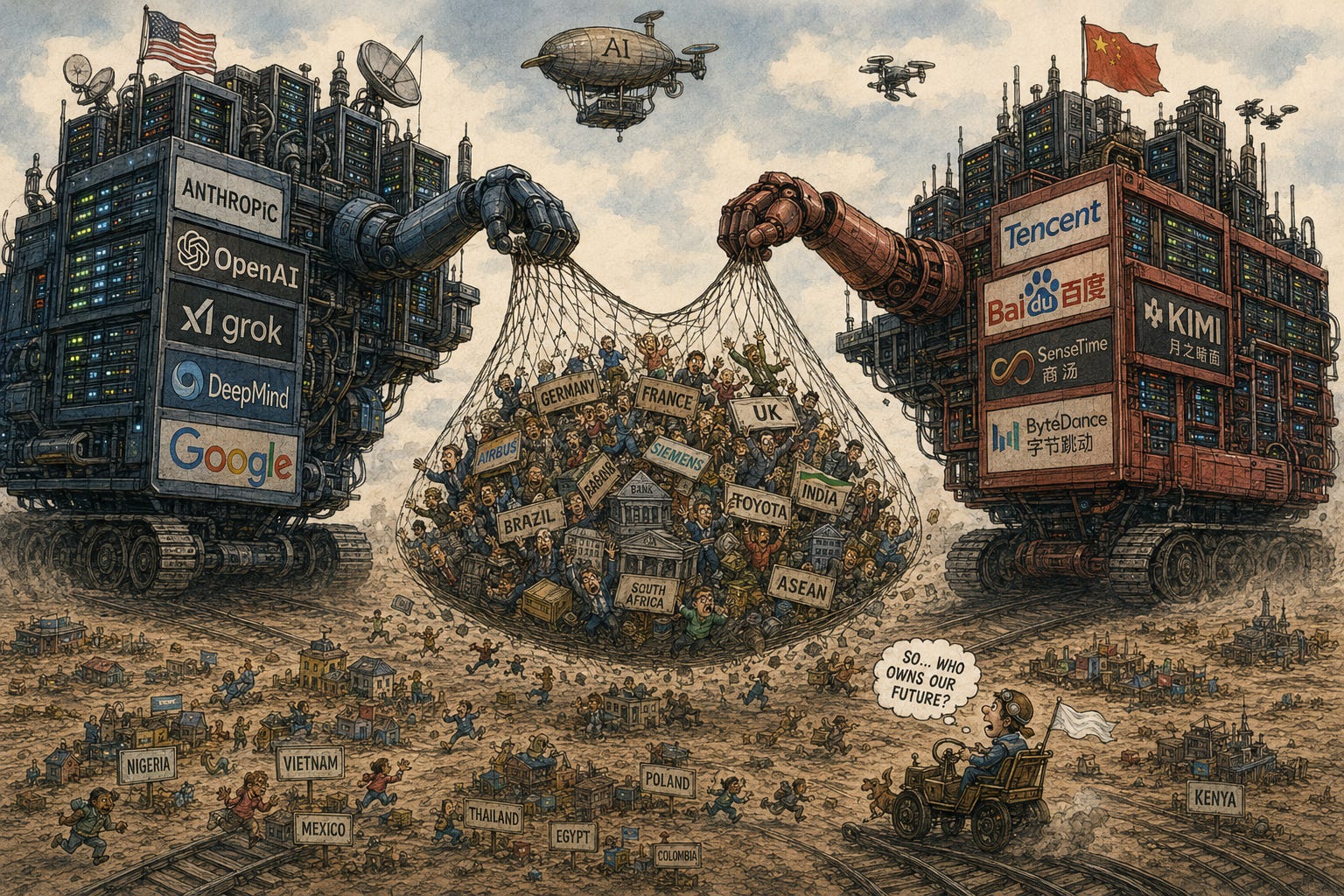
In April 2026 the model briefly topping the open-weight leaderboards was not ChatGPT, Claude or Gemini. It was Kimi K2.6, from a Beijing start-up most Western officials could not name, let alone pronounce. It is free to download, tunable in any language and now a fact of geopolitical life. So much for the reassuring story that the frontier is American, and always will be.
The point is not the ranking but the plumbing beneath it. Access to frontier artificial intelligence (AI), and to the compute, chips, energy and data behind it, has become a lever of statecraft. Control of the cognitive layer of the economy is what control of energy was in the 20th century: the commanding height. The novelty is that the terms of access to this one can be revised remotely, in software, between one fiscal quarter and the next, or on a single presidential whim.
The same shift is visible on three fronts. In AI, China’s cheap, open and locally adaptable models are winning precisely the ground that centralised Western systems priced out or sanctioned away. In finance, crypto rails are assembling a parallel settlement system across the global south, one sanction at a time. And quantum computing is the accelerant, quietly shortening the decade in which anyone still gets to choose deliberately.
All of which is awkward for the allies who built their digital strategies on the assumption of an open American base, and are discovering, late, that the assumption was always conditional. Hosting is not owning. Renting is not building. Those who do not build will be tenants, and the rent is going to rise.
I set out the full argument in an essay for the Centre for International Governance Innovation (CIGI). Read it below.

‘Sovereignty by download’ – Rafal Rohozinski, CIGI, June 2026] https://www.cigionline.org/articles/sovereignty-by-download/
Rafal Rohozinski is the founder and CEO of Secdev Group, a senior fellow at the Centre for International Governance Innovation (CIGI), and co-chair of the Canadian AI Sovereignty and Innovation Cluster.
SecDev’s geopolitical risk practice - builds on three decades of fieldwork across 120+ countries industrialized into on-demand strategic advantage. The era of treating geopolitical risk as an externality is over. Supply chains now span hostile borders, critical technologies depend on adversarial states, and market access hinges on diplomatic whims. What was once the domain of foreign ministries has become every CEO’s problem. SecDev’s Intelligence as a Service delivers tiered, contract-free engagement: from real-time assessments that move faster than markets to deep-dive analysis that uncovers the networks and contacts buried in geopolitical complexity. The question isn’t whether geopolitical shocks will hit your business - it’s whether you’ll see them coming.
SecDev AI
SecDev AI delivers first-in-class Data as a Service AI solutions combining highly trained models with unique, curated datasets. Our next-generation, precision-built expert systems meet the most demanding requirements. By integrating data curation with advanced machine learning, we provide specialized tools that deliver actionable insights where accuracy and reliability are paramount.